
Carbon steel, stainless steel, hardness, toughness, and those mysterious letters and numbers—what really matters when choosing a knife?
Walk into a knife shop or browse an online catalog, and you’ll quickly encounter an alphabet soup of steel names: 1095, 440C, VG-10, D2, S30V, MagnaCut.
Manufacturers often advertise these names as though everyone knows what they mean. But unless you’ve studied metallurgy or spent years collecting knives, the differences may be far from obvious.
Is stainless steel always better? Does harder steel stay sharp longer? Is an expensive steel automatically superior to a less costly one?
The answer to all three questions is no.
Understanding knife steel isn’t about memorizing dozens of alloys. It’s about learning how different steels balance a handful of important properties—and recognizing which properties matter most for the way you use your knife.
Let’s start with the basics.
1. What Is Knife Steel?
Steel is an alloy made primarily of iron and carbon, often with additional elements that influence its properties.
Pure iron is relatively soft. Adding carbon allows steel to develop much greater hardness through appropriate heat treatment.
But carbon is only part of the story.
Knife steels may also contain chromium, vanadium, molybdenum, manganese, nickel, and other elements. Each contributes to the steel’s behavior, although the results depend on the complete alloy composition and how the steel is processed.
For example:
- Carbon plays a major role in the steel’s ability to harden and form carbides.
- Chromium can improve corrosion resistance and contribute to wear-resistant carbides.
- Vanadium can form very hard carbides that improve wear resistance and can help refine grain structure.
- Molybdenum can improve hardenability and contribute to corrosion and wear resistance in suitable alloys.
- Nickel can improve toughness in certain steel compositions.
Think of steelmaking as a recipe. The ingredients matter, but so do their proportions and the way they’re prepared.
Two knives made from the same named steel can perform differently because of differences in heat treatment, blade geometry, and manufacturing quality.
The steel name tells you something important—but it never tells you everything.
2. Carbon Steel vs. Stainless Steel
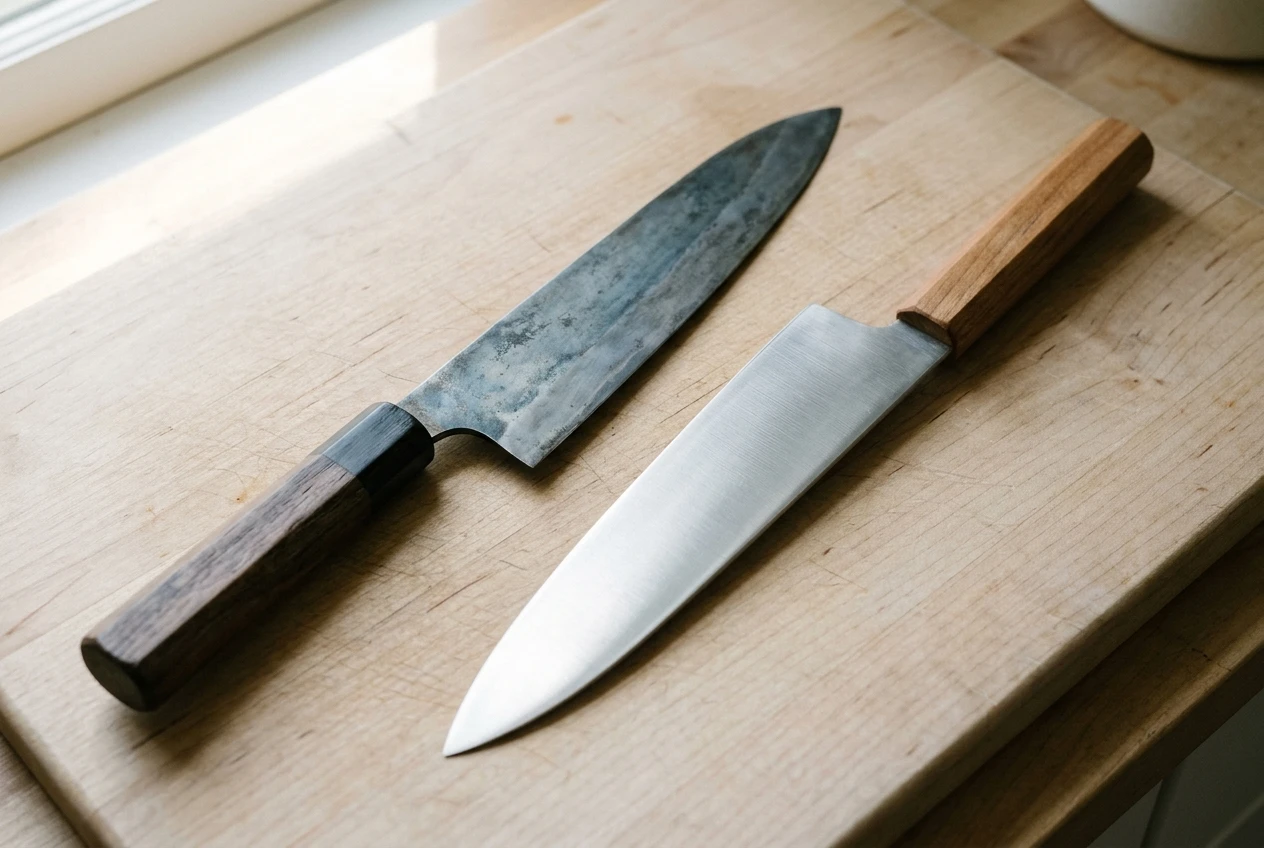
Two contrasting blade finishes: carbon steel with a developed patina (left) and bright stainless steel (right). Actual corrosion resistance depends on the steel composition and care.
One of the first distinctions beginners encounter is the difference between carbon steel and stainless steel.
Carbon Steel
In knife terminology, carbon steel usually refers to steels with relatively little chromium and limited corrosion resistance.
Common examples include 1095, 1075, and 1084.
Carbon steels are popular in traditional knives, woodworking tools, and some outdoor blades.
Advantages:
- Many are relatively straightforward to sharpen.
- Some offer excellent toughness when properly heat-treated.
- They can provide strong performance at reasonable prices.
Disadvantages:
- They generally require more attention to prevent rust.
- They can develop discoloration or a patina through use.
- Their performance varies considerably with composition and heat treatment.
A patina is a surface discoloration that develops as steel reacts with its environment. It is not the same as destructive red rust, although a patina does not make a blade completely rustproof.
Carbon steel is not inherently sharper than stainless steel. Both can take excellent edges when properly manufactured and sharpened.
Stainless Steel
Stainless steels contain enough chromium to provide significant corrosion resistance. A common metallurgical threshold is approximately 10.5% chromium, although practical corrosion resistance depends on the alloy and processing.
Popular stainless knife steels include 420HC, 440C, 14C28N, VG-10, and CPM S30V.
Advantages:
- Generally better resistance to rust and staining.
- Convenient for kitchens, humid environments, and everyday carry.
- Available in a wide range of performance levels and prices.
Disadvantages:
- Some high-wear-resistance grades can be more difficult to sharpen.
- Not every stainless steel offers high toughness or excellent edge retention.
- Stainless does not mean completely rustproof.
Saltwater, prolonged moisture, and improper care can still cause corrosion.
Which Is Better?
Neither category wins universally.
A carbon-steel outdoor knife may be an excellent choice for someone who values easy field sharpening and is willing to maintain the blade.
A stainless kitchen knife may be more convenient for someone who frequently works with acidic foods or washes and dries the knife throughout the day.
The important question isn’t simply whether a steel is carbon or stainless.
It’s whether its properties suit the job.
3. The Four Properties Every Knife Buyer Should Understand
Most discussions about knife steel eventually come down to four important characteristics.
Edge Retention
Edge retention describes how well a blade maintains useful cutting performance during use.
A steel with good wear resistance may retain its edge longer during abrasive cutting, such as repeated slicing through cardboard.
But edge retention is not determined by steel alone. Edge angle, blade geometry, hardness, the material being cut, and the type of cutting all influence the result.
Toughness
Toughness is a material’s ability to resist fracture and damage under stress.
A tough blade is less likely to chip or break when subjected to impacts or demanding work.
This matters particularly for outdoor knives and other tools that may encounter unpredictable loads.
Toughness should not be confused with hardness. A very hard steel is not necessarily a tough one.
Corrosion Resistance
Corrosion resistance describes how well a steel resists chemical attack from moisture, salts, acids, and other environmental conditions.
For kitchen knives, fishing knives, and blades carried in humid climates, this property can be especially important.
Even corrosion-resistant knives benefit from cleaning and drying after use.
Ease of Sharpening
Some steels are easier to sharpen than others.
Simple carbon steels and certain lower-alloy stainless steels often respond readily to ordinary sharpening stones.
Steels containing substantial quantities of hard wear-resistant carbides may require more effort or suitable abrasives.
Ease of sharpening is not identical to edge retention. A steel that sharpens quickly may need more frequent maintenance, while a highly wear-resistant steel may take longer to restore.
The Trade-Off
These properties interact, and steel selection involves compromises.
A knife optimized for maximum abrasive wear resistance may not offer the toughness or ease of sharpening desired for a different task.
Modern metallurgy has produced steels with impressive combinations of properties, but there is still no single steel that is best for every knife.
4. Understanding the Rockwell Hardness Scale
Knife specifications frequently include a number followed by the letters HRC.
For example:
60 HRC
This refers to hardness measured using the Rockwell C scale.
The test measures resistance to indentation under standardized conditions.
In general, a higher HRC number indicates harder steel.
Many kitchen and everyday-carry knives fall somewhere in the broad range of approximately 55–63 HRC, although knives outside that range also exist.
Hardness influences how a cutting edge behaves, but it is not a complete measure of quality.
A harder blade may resist certain forms of edge deformation better, yet it may also be more vulnerable to chipping if the steel, heat treatment, and edge geometry are not suited to the task.
A softer blade may deform or roll at the edge rather than chip under some conditions.
Higher HRC does not automatically mean a better knife.
Instead of searching for the highest number, look for a hardness appropriate to the steel and intended use.
5. Why Heat Treatment Matters So Much
Two blades made from the same steel can behave surprisingly differently.
One may hold an edge beautifully, while another dulls quickly or chips during ordinary use.
A major reason is heat treatment.
Heat treatment involves controlled heating and cooling to develop the desired microstructure and mechanical properties.
Depending on the steel, the process may involve several stages, including hardening, quenching, tempering, and sometimes additional treatments.
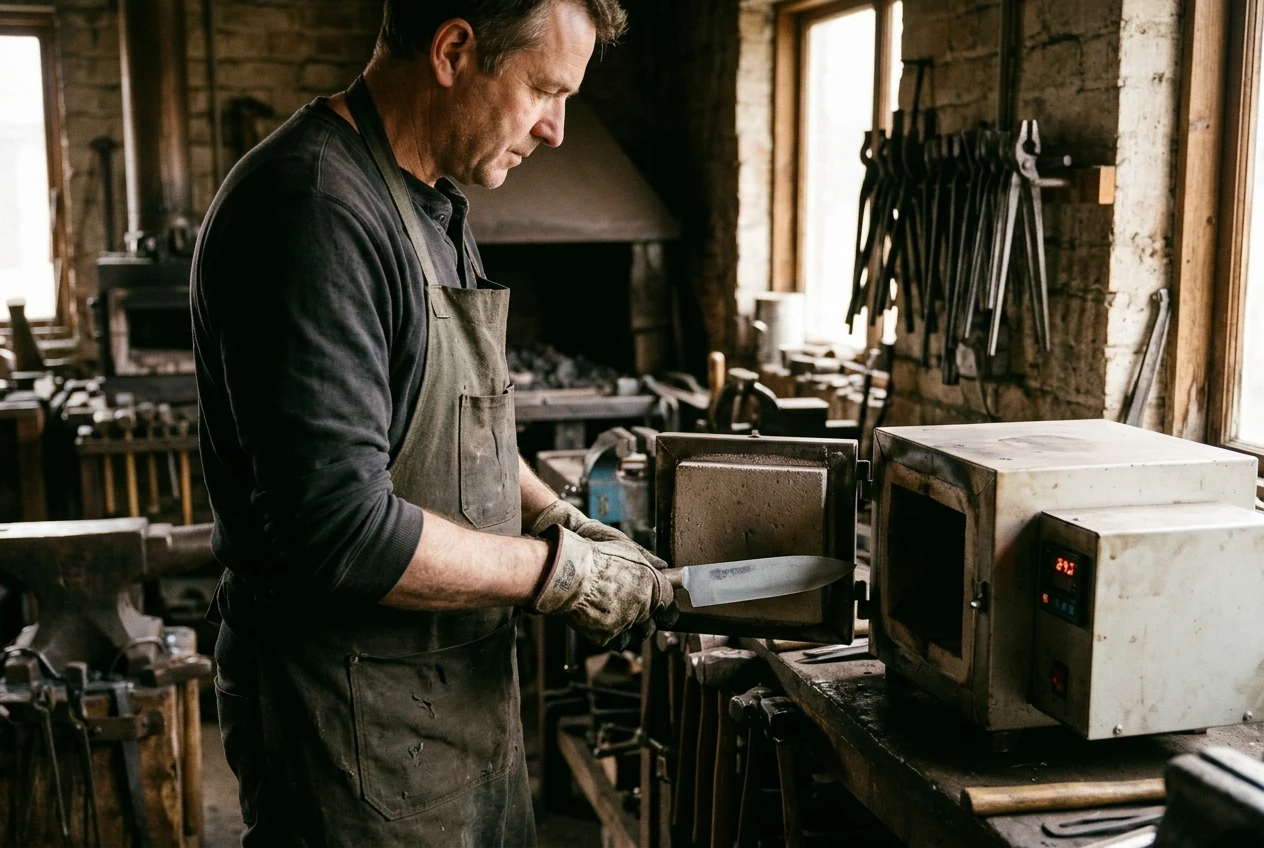
Tempering follows hardening and helps adjust a blade’s hardness and toughness. Precise temperature control is essential to achieving the desired properties.
Hardening and Quenching
During hardening, steel is heated under controlled conditions and then cooled at a suitable rate.
For many knife steels, this produces a hard microstructure known as martensite.
Different alloys require different temperatures, cooling methods, and processing schedules.
Tempering
After hardening, steel is usually tempered by reheating it to a lower temperature for a controlled period.
Tempering helps reduce brittleness and adjust the balance between hardness and toughness.
Why This Matters to Buyers
The steel printed on a blade is only the beginning of its story.
A well-executed heat treatment can help an affordable steel perform extremely well.
Conversely, an expensive alloy can disappoint if its heat treatment is poorly controlled.
This is one reason a reputable manufacturer’s quality control matters just as much as an impressive steel designation.
6. What Do Knife Steel Names Actually Mean?
Knife steels are identified through several different naming systems.
Some names describe standardized alloy compositions. Others are proprietary trade names used by steel manufacturers.
Understanding a few common examples makes the terminology much less intimidating.
Steel | General characteristics | Common applications |
|---|---|---|
1095 | Simple, high-carbon steel with low corrosion resistance | Traditional and outdoor knives |
420HC | Corrosion-resistant stainless steel, often relatively easy to sharpen | Budget and utility knives |
440C | High-carbon stainless steel with useful wear resistance | Traditional folders and general-purpose knives |
8Cr13MoV | Affordable stainless steel with moderate performance | Budget everyday-carry knives |
14C28N | Stainless steel known for a useful balance of toughness, corrosion resistance, and edge performance | Kitchen and EDC knives |
VG-10 | Stainless steel popular in Japanese kitchen cutlery | Kitchen knives and folders |
D2 | High-carbon, high-chromium tool steel with good abrasive wear resistance but limited stainless-like corrosion protection | Utility and EDC knives |
CPM S30V | Powder-metallurgy stainless steel developed for knife applications | Premium folding knives |
CPM MagnaCut | Modern powder-metallurgy stainless steel designed for a strong combination of toughness, corrosion resistance, and wear resistance | Premium kitchen, outdoor, and EDC knives |
These are broad descriptions, not guarantees of performance.
What About the Numbers?
In the 10xx carbon-steel series, the last two digits indicate approximate nominal carbon content in hundredths of a percent.
For example, 1095 contains approximately 0.95% carbon.
But don’t assume that every steel name follows this pattern.
The names 440C, VG-10, D2, and S30V come from different naming systems or product designations.
A steel name is best treated as an identifier that you can look up—not a universal code that reveals every property.
7. What Is Powder Metallurgy Steel?
You may see knife manufacturers advertise CPM, PM, or powder-metallurgy steels.
Traditional steel production generally involves melting and casting an alloy, followed by processing it into usable forms.
Powder metallurgy takes a different approach.
Molten steel is converted into fine droplets that solidify into powder. The powder is then consolidated into solid material under controlled conditions.
This can produce a more uniform distribution of alloying elements and carbides, particularly in highly alloyed steels.
The process allows manufacturers to create compositions that would be more difficult to produce with conventional methods.
However, powder metallurgy is not automatically superior in every application.
A well-designed, properly heat-treated conventional steel can outperform a poorly selected or poorly processed powder-metallurgy steel.
Again, the complete knife matters more than any single manufacturing label.
8. What About Damascus Steel?
Few blade materials attract as much attention as Damascus steel.
Its flowing patterns can resemble wood grain, rippling water, or swirling smoke.
But the word Damascus is used in several different ways.
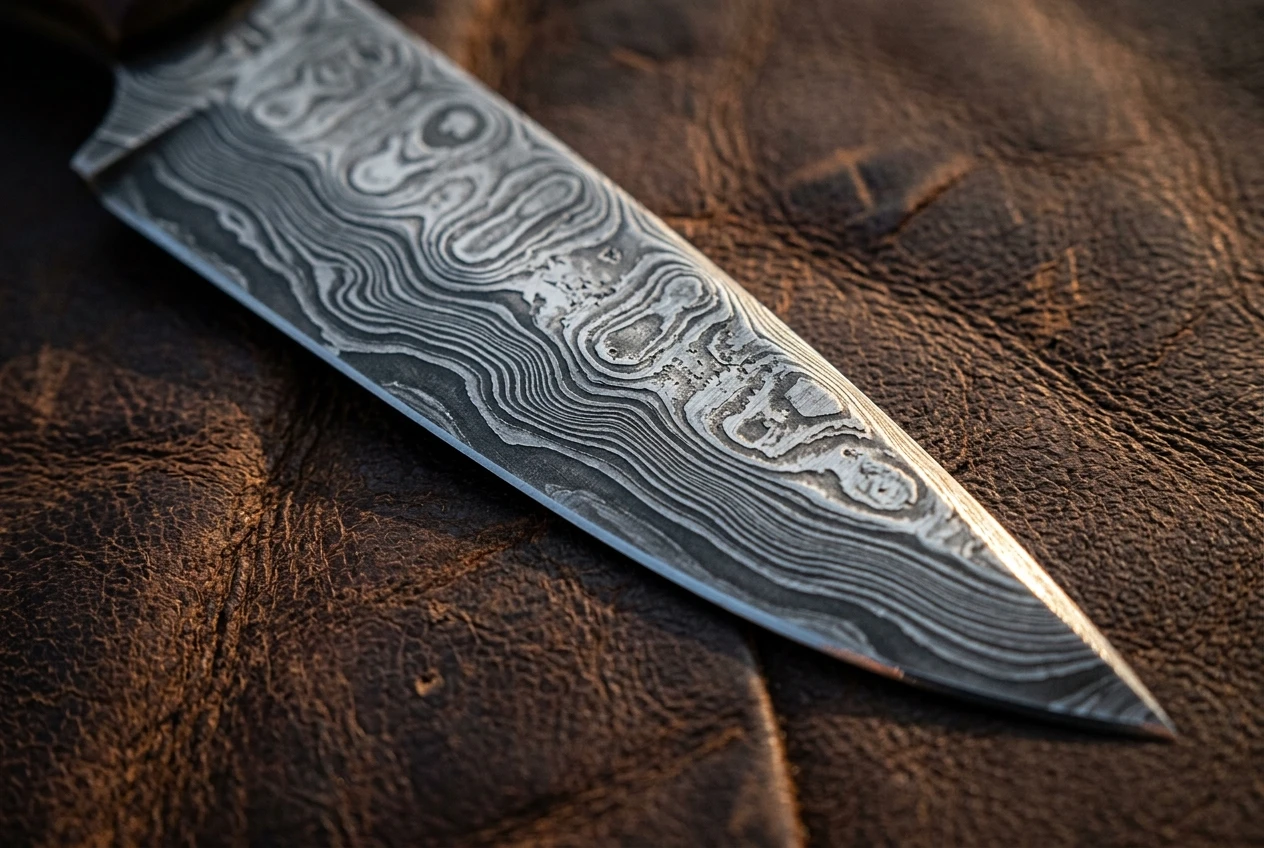
Historically, the term has been associated with patterned crucible steels, including wootz steel, whose metallurgy differs from many modern patterned blades.
Today, most knives marketed as Damascus use pattern-welded steel.
This process involves combining layers of different steels, forge-welding them, and manipulating the material to produce distinctive patterns.
The finished blade is often etched to reveal contrasting layers.
Is Damascus Better?
Not necessarily.
A beautiful pattern tells you little about the blade’s actual hardness, toughness, or edge retention.
Modern pattern-welded Damascus can be made into excellent knives, but its performance depends on the constituent steels, manufacturing process, heat treatment, and blade geometry.
Damascus should be appreciated for its craftsmanship and appearance—not assumed to be superior simply because it is patterned.
9. Choosing Steel for the Way You Use Your Knife
Now that we understand the basic properties, let’s put them to work.
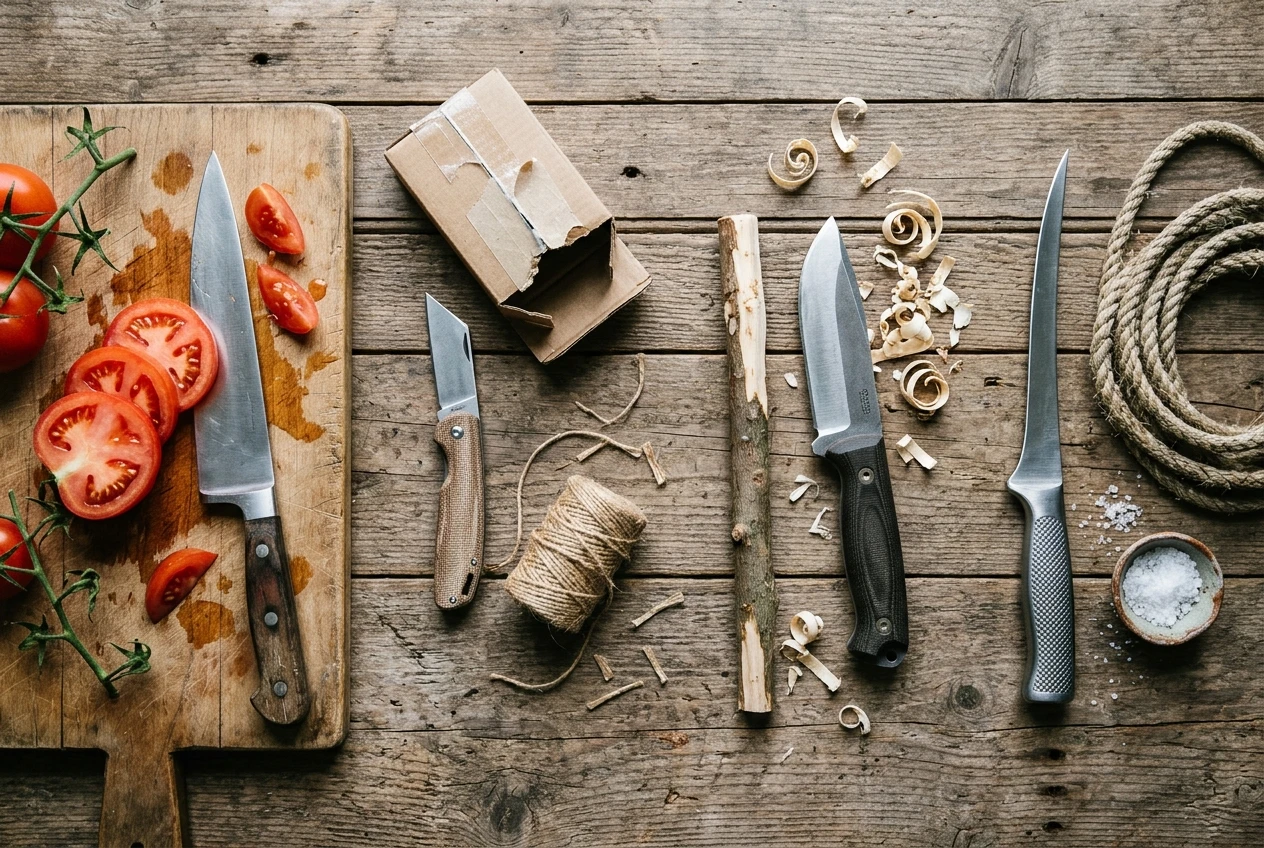
From kitchen preparation to everyday cutting, woodworking, and fishing, different tasks demand different combinations of blade design, steel properties, and durability.
Kitchen Knives
For most home cooks, corrosion resistance, practical edge retention, and ease of maintenance are important.
A well-made stainless knife is often an excellent choice.
Someone who enjoys traditional carbon-steel cutlery may prefer its sharpening characteristics and be comfortable with the extra maintenance.
Remember that blade geometry and handle comfort can make a greater difference in daily cutting performance than upgrading to a more expensive steel.
Everyday Carry Knives
An everyday-carry knife may open packages, cut cord, trim materials, and handle a wide variety of small tasks.
A balanced steel with good corrosion resistance and manageable sharpening requirements is often more useful than one optimized solely for maximum edge retention.
For many people, a reasonably priced, well-constructed knife is all that’s necessary.
Outdoor Knives
Outdoor knives face varied conditions, including moisture, dirt, and demanding cutting tasks.
Toughness, corrosion resistance, blade geometry, and ease of field maintenance may all matter.
A knife intended for controlled carving has different requirements from a knife intended for heavier camp chores.
No steel designation can compensate for using a knife beyond its design limits.
Knives for Wet or Coastal Environments
Frequent exposure to moisture and salt increases the importance of corrosion resistance.
Some stainless steels are particularly well suited to these environments.
But even highly corrosion-resistant knives should be cleaned and dried appropriately.
10. Five Common Myths About Knife Steel
Myth 1: Stainless steel never rusts.
Stainless steel resists corrosion; it is not completely immune to it.
Myth 2: The hardest steel makes the best knife.
Hardness is only one property. Toughness, geometry, heat treatment, and intended use also matter.
Myth 3: Carbon steel is always sharper than stainless steel.
Both can achieve extremely sharp edges. Sharpening quality, microstructure, and edge geometry are important.
Myth 4: More expensive steel always means better performance.
Premium alloys can offer genuine advantages, but those advantages may not matter for every task or justify the added cost.
Myth 5: Damascus steel is automatically superior.
Its visible pattern is not proof of better cutting performance.
11. A Beginner’s Knife Steel Checklist
Before buying a knife, ask yourself:
- What will I cut most often? Food, cardboard, rope, wood, or something else?
- Will the knife encounter moisture or salt? If so, corrosion resistance deserves greater attention.
- Am I comfortable sharpening it? Some steels require more time or specialized abrasives.
- Will the blade experience impact or twisting forces? Toughness and appropriate construction become important.
- Is the manufacturer reputable? Consistent heat treatment and quality control are essential.
- Does the knife feel comfortable and balanced? Steel alone cannot make an uncomfortable knife enjoyable to use.
- Am I paying for useful performance or an impressive name? The most expensive alloy is not always the wisest purchase.
Conclusion: The Best Steel Is the One That Fits the Job
Knife steel is fascinating because it combines chemistry, engineering, craftsmanship, and practical experience.
But beginners needn’t memorize every alloy or chase the latest premium designation.
Start with the fundamentals: edge retention, toughness, corrosion resistance, and ease of sharpening.
Then consider how those properties interact with heat treatment, blade geometry, and the work your knife will perform.
A modestly priced knife made from a suitable steel, properly heat-treated and thoughtfully designed, can provide years of excellent service.
The goal isn’t to own the knife with the most impressive specifications.
It’s to understand what you’re buying—and why it works.
Where the Edge Matters.