
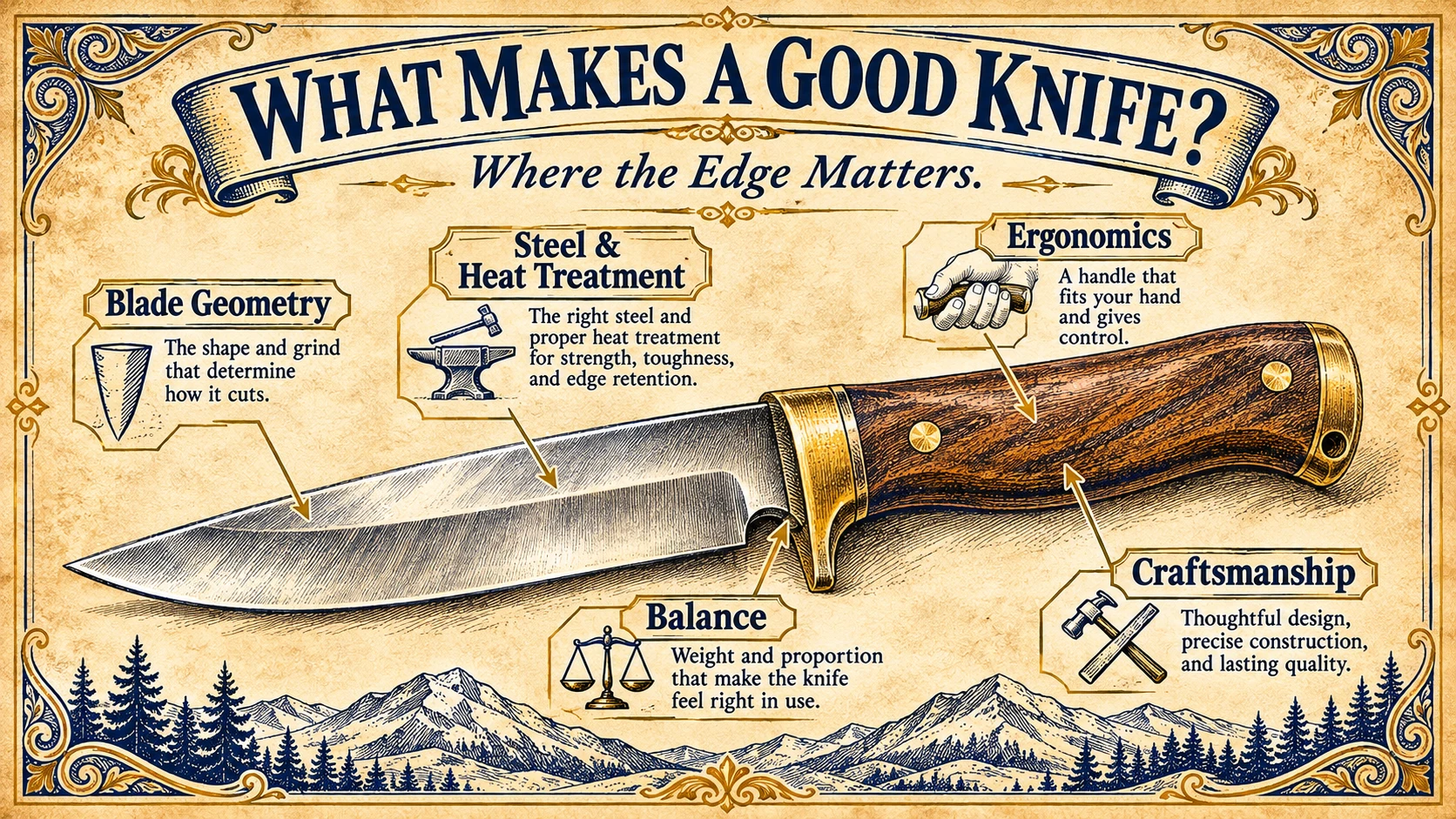
Steel, balance, geometry, and craftsmanship: understanding what separates a great knife from an ordinary one.
A knife is one of humanity’s oldest and most useful tools. From the earliest sharpened stones to today’s precision-engineered blades, its fundamental purpose has remained remarkably simple: to cut.
Yet anyone who has spent time using knives knows that some are a pleasure to work with, while others seem to fight you at every turn.
One knife glides effortlessly through a tomato. Another crushes the skin before making a cut. One pocketknife feels like a natural extension of your hand. Another develops uncomfortable pressure points after only a few minutes.
What makes the difference?
Is it the steel? The sharpness? The weight? The price?
The answer is more interesting than any single specification.
A good knife is the result of several elements working together: blade geometry, steel, heat treatment, balance, ergonomics, construction, and intended purpose.
Understanding these elements can help you recognize genuine quality without relying on brand names, marketing claims, or impressive price tags.
1. Blade Geometry: The Shape Behind the Sharpness
When most people evaluate a knife, they begin with its sharpness. But sharpness is only part of the story.
Two knives can have equally sharp edges and perform very differently because of their blade geometry.
Blade geometry refers to the shape and dimensions of the blade, including its thickness, taper, grind, and cutting-edge angle.
Thickness Matters
A thin blade generally moves through soft materials with less resistance than a thick blade.
Consider a kitchen knife designed for slicing vegetables. A thin blade with an efficient grind can pass through an onion with relatively little effort.
A heavy outdoor knife, by contrast, may have a thicker blade designed to withstand demanding work. It may be stronger for certain tasks, but it will usually require more force to make the same delicate slice.
Neither design is inherently better.
The important question is whether the blade’s geometry suits the work it is intended to perform.
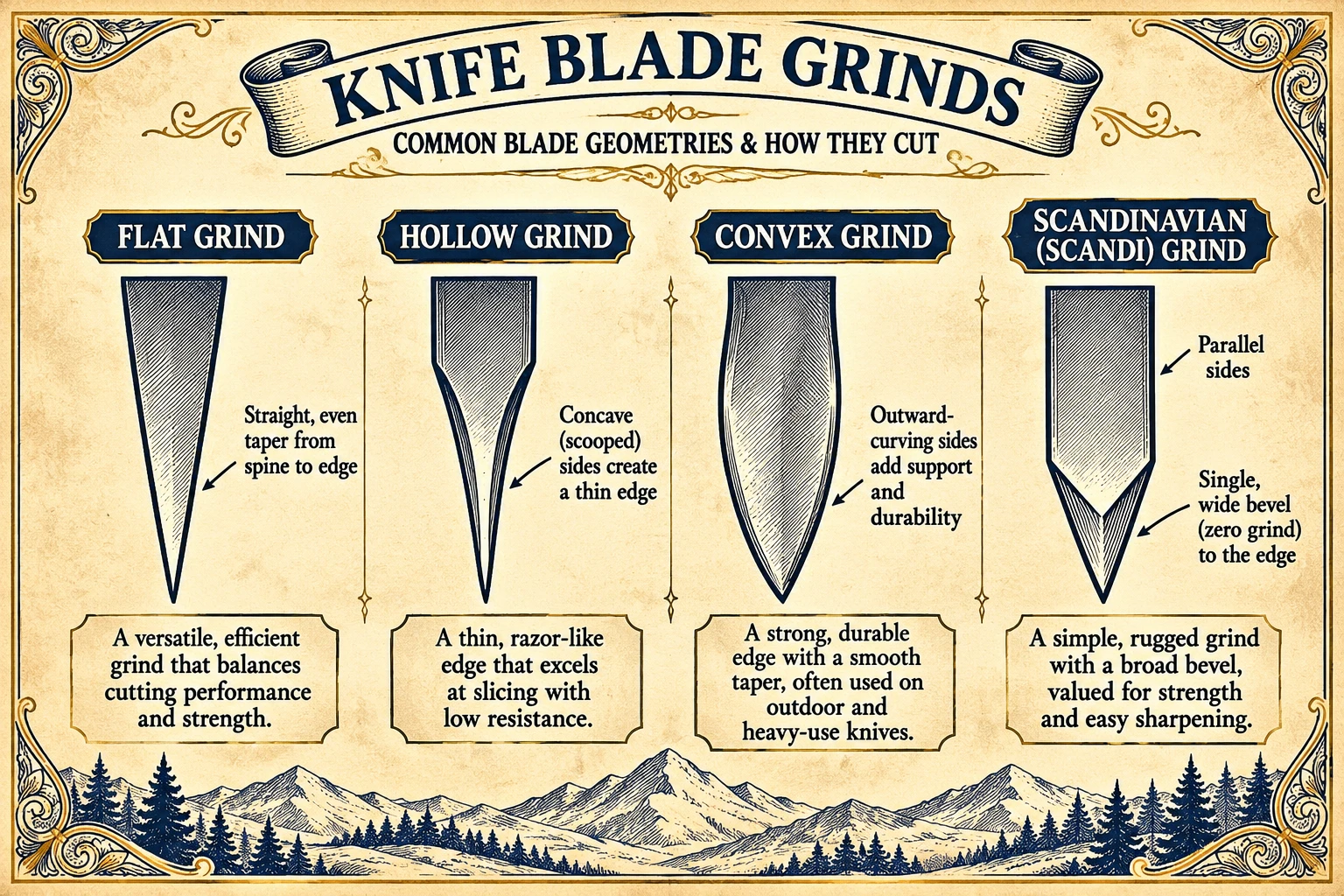
Understanding Blade Grinds
The grind describes how the blade’s sides taper toward the cutting edge.
Common grinds include:
- Flat grind: A versatile design that can provide efficient cutting performance.
- Hollow grind: Concave blade faces create a thin region behind the edge, often producing excellent slicing performance.
- Convex grind: A smoothly curved profile that can provide additional support behind the cutting edge.
- Scandinavian (Scandi) grind: A broad primary bevel extending toward the edge, popular on many woodworking and bushcraft knives.
Each involves trade-offs in cutting resistance, durability, and ease of maintenance.
A well-designed blade does not simply have a sharp edge. Its entire cross-section contributes to how it cuts.
2. Steel: More Than Just Hardness
Knife manufacturers frequently advertise their steels as though the steel designation alone determines quality.
You may encounter terms such as high-carbon steel, stainless steel, tool steel, or powder metallurgy steel.
These descriptions tell us something about the material, but they don’t tell the whole story.
A good knife steel must balance several properties.
Hardness
Hardness describes a material’s resistance to localized deformation, such as indentation.
Knife hardness is commonly measured on the Rockwell C scale (HRC).
Harder steel can support certain edge designs and may resist edge deformation better, but greater hardness does not automatically produce a better knife.
Excessive hardness for a particular steel and application can increase the risk of chipping or fracture.
Toughness
Toughness is the ability to absorb energy and resist fracture.
This matters particularly for knives subjected to impacts, twisting forces, or demanding outdoor use.
A steel optimized for maximum wear resistance may not be the best choice for a large chopping knife.
Edge Retention
Edge retention describes how long a knife maintains useful cutting performance.
It depends on more than hardness alone. Steel composition, microstructure, blade geometry, heat treatment, and the material being cut all influence the result.
Corrosion Resistance
Stainless steels are formulated to resist corrosion, typically through sufficient chromium in the alloy.
However, stainless does not mean completely rustproof.
Saltwater, moisture, acidic foods, and poor maintenance can damage even corrosion-resistant blades.
Ease of Sharpening
Some steels are easier to sharpen than others.
A knife that holds its edge exceptionally well may require more effort or specialized abrasives to restore it.
For many users, a steel that sharpens readily and performs reliably may be more practical than one designed for maximum wear resistance.
The best steel is not necessarily the most expensive or technically advanced. It is the steel whose properties suit the knife’s purpose.
3. Heat Treatment: The Invisible Ingredient
Two knives made from the same steel can behave very differently.
Why?
One important reason is heat treatment.
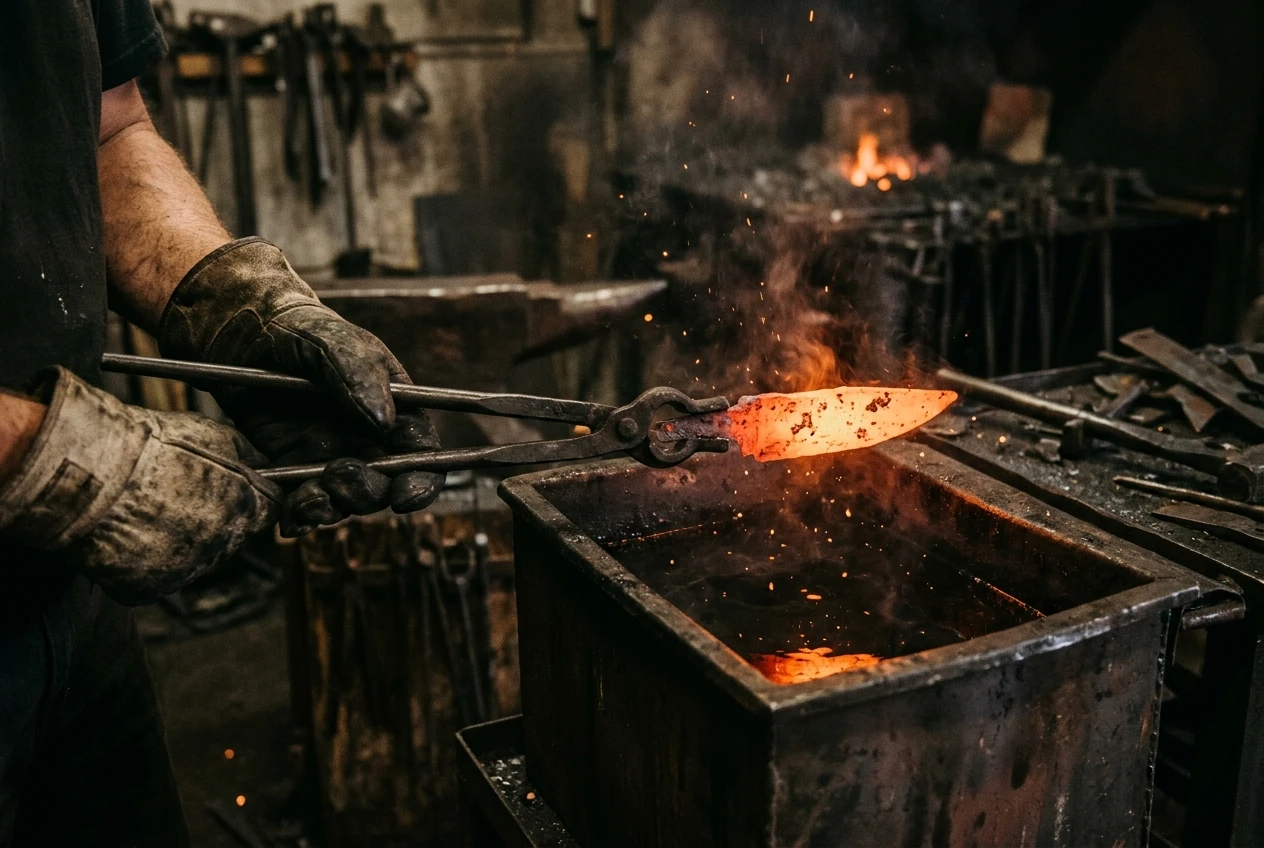
Heat treatment helps determine a blade’s hardness and toughness. During quenching, heated steel is cooled under controlled conditions to develop the desired microstructure.
During manufacturing, steel is heated and cooled under controlled conditions to develop the desired microstructure and mechanical properties.
Depending on the steel, this may involve hardening, quenching, tempering, and other specialized processes.
Heat treatment influences hardness, toughness, dimensional stability, and performance.
A poorly heat-treated premium steel may perform worse than a modest steel treated appropriately.
This is one reason experienced knife enthusiasts pay attention not only to the steel designation but also to the reputation and quality control of the manufacturer.
You cannot determine the quality of heat treatment simply by looking at a finished blade.
Reliable testing, manufacturer information, and long-term experience are much more informative than appearance alone.
4. Balance: When a Knife Feels Like an Extension of Your Hand
Pick up a well-designed knife and you may immediately notice something difficult to describe.
It feels right.
The weight seems natural. The handle sits comfortably in your palm. The blade responds predictably.
Balance contributes to this sensation.
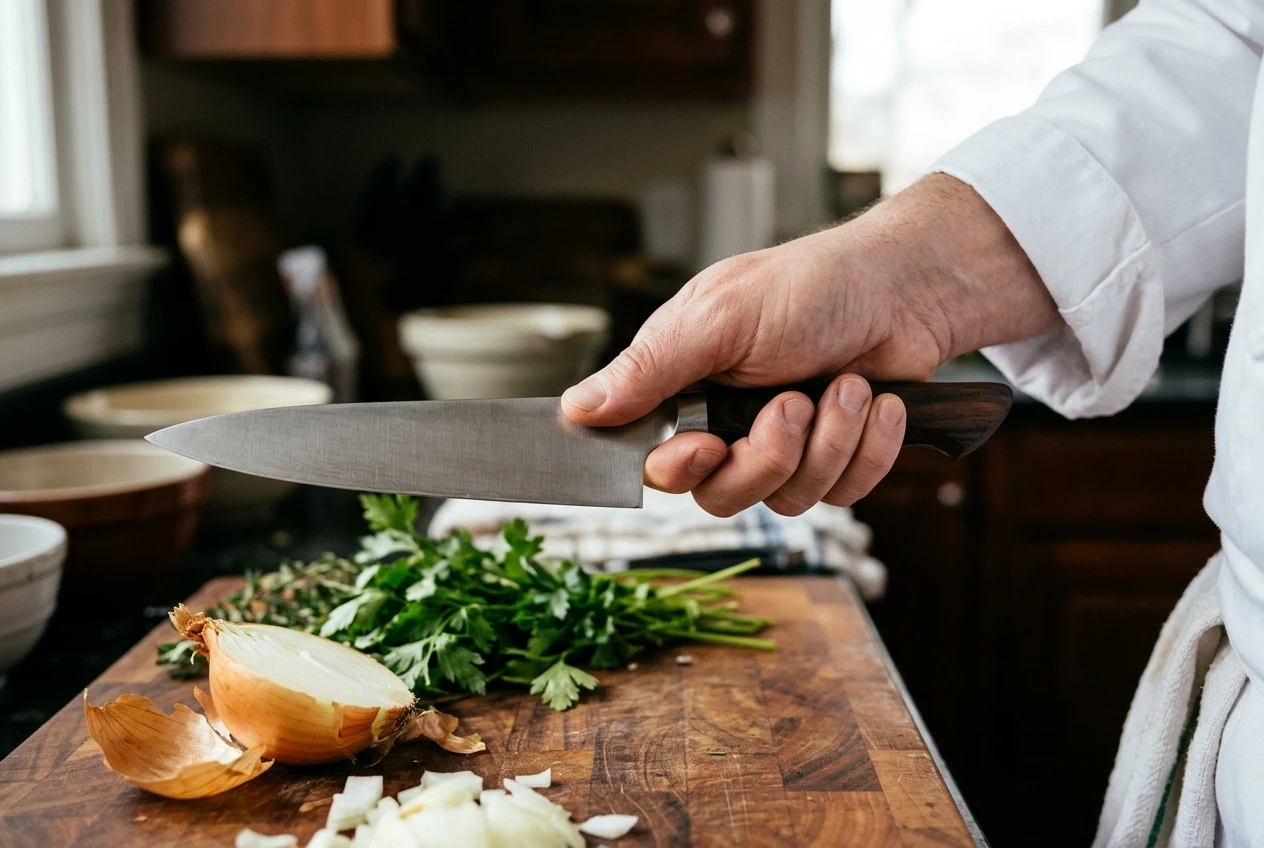
The relationship between blade weight, handle design, and grip affects how naturally a knife feels and responds in the hand.
What Is the Balance Point?
Every knife has a center of mass—the point at which its weight can be balanced.
On many chef’s knives, that point lies near the junction of the blade and handle, although the ideal position depends on the design and the user’s grip.
A blade-heavy knife places more mass toward the tip. This can be useful for certain chopping motions.
A handle-heavy knife may feel more maneuverable to some users, particularly during detailed work.
Neither arrangement is universally superior.
How to Evaluate Balance
The safest and most useful method is to hold the knife normally and assess how it feels.
With a kitchen knife, try a comfortable pinch grip near the heel of the blade, keeping your fingers away from the cutting edge.
Notice whether the blade feels as though it is constantly pulling downward or whether the handle feels awkwardly heavy.
Then consider the intended cutting motion.
Does the knife move naturally? Can you control its direction without excessive wrist effort?
A knife that feels comfortable during a brief inspection may still cause fatigue during extended use, so actual cutting experience is valuable.
The Finger Balance Test
You may have seen knives balanced across a finger to demonstrate their center of mass.
This can reveal approximately where the knife’s weight is concentrated, but it does not establish whether the knife is well designed.
It also introduces an unnecessary risk of slipping or injury.
A better approach is to evaluate balance through a secure grip and controlled use.
Good balance is not about achieving one perfect point. It is about matching weight distribution to the task and the person using the knife.
5. Handle Ergonomics: The Human Side of Knife Design
A beautiful blade is of little value if its handle makes it uncomfortable or unsafe to use.
Ergonomics concerns how the tool interacts with the human hand.
Several characteristics deserve attention.
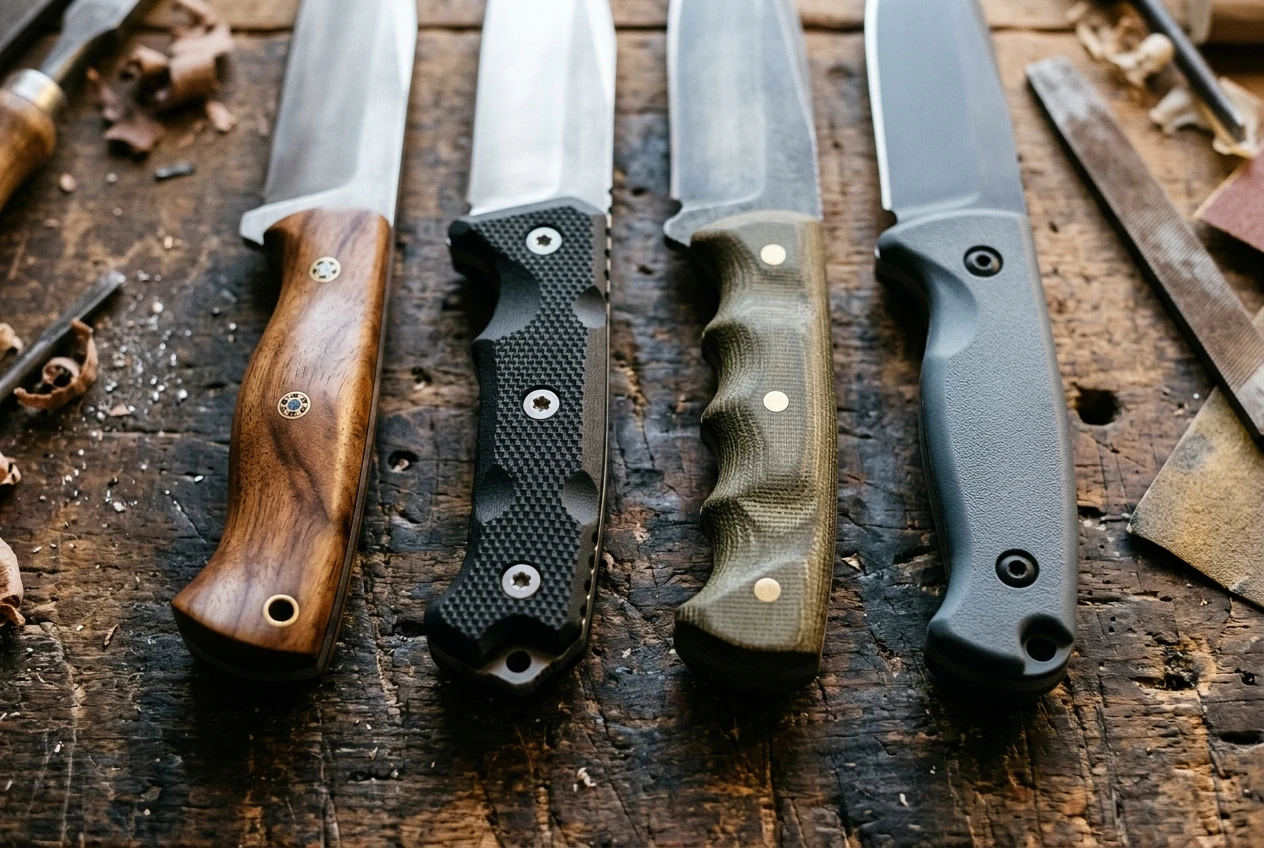
Knife handles vary in material, texture, and shape. From natural wood to modern synthetics, the best handle combines a secure grip with comfort and control.
Handle Shape
A comfortable handle should allow a secure grip without forcing the hand into an unnatural position.
Excessively sharp corners, poorly placed finger grooves, and pronounced pressure points can become uncomfortable during repeated cutting.
Handle Size
Hands vary considerably in size and shape.
A handle that feels ideal to one person may be awkward for another.
This is why handling a knife before purchasing it can be more informative than studying specifications alone.
Handle Materials
Common materials include wood, stabilized wood, G10, Micarta, metals, and various polymers.
Each has advantages and limitations involving durability, moisture resistance, maintenance, weight, and texture.
A polished wooden handle may feel wonderful in dry conditions but require additional care.
A textured synthetic handle may offer a secure grip with relatively little maintenance.
Material choice should reflect the knife’s intended environment.
Grip Security
A good handle should help the user maintain control, including when hands are damp.
However, aggressive texturing can become uncomfortable during prolonged use.
As with most aspects of knife design, balance and compromise matter.
6. Construction: Quality You Can See and Feel
Construction quality is one of the most revealing aspects of a knife.
Even an excellent steel cannot compensate for poor assembly, loose components, or careless finishing.
Fixed-Blade Knives
Fixed-blade knives have a blade that does not fold into the handle.
The tang—the portion of the blade extending into the handle—plays an important structural role.
Full-tang construction is often valued for durability, particularly in demanding applications, but a well-engineered partial or hidden tang can also be strong and appropriate for its intended use.
Tang design alone does not determine quality.
For a closer look at full, partial, and hidden tang designs, see our article The Anatomy of a Knife.
Folding Knives
Folding knives introduce additional mechanical considerations.
Look for:
- Smooth, controlled blade movement.
- A secure locking mechanism, if the knife is designed with one.
- Minimal unintended blade play.
- Properly fitted components.
- Comfortable access to the opening and closing mechanisms.
No folding knife lock is infallible. Proper use and maintenance remain essential.
Fit and Finish
Fit and finish refers to the precision and care evident in a knife’s assembly.
Look for uneven gaps, rough edges, loose handle scales, misaligned components, or poorly finished surfaces.
A knife does not need elaborate decoration to demonstrate good craftsmanship.
Sometimes the most impressive quality is the absence of anything distracting.
7. Sharpness and Edge Quality
A new knife should arrive with an edge appropriate to its intended use.
But an exceptionally sharp factory edge is not necessarily evidence of superior overall quality.
Sharpness describes the condition and geometry of the cutting edge at a particular moment.
Edge durability describes how that edge behaves during use.
A thin, acute edge may slice beautifully but be vulnerable to damage during demanding tasks.
A more robust edge may sacrifice some cutting efficiency in exchange for greater resistance to deformation or chipping.
The ideal edge depends on what the knife is expected to cut.
And remember: even an excellent knife eventually needs sharpening.
The ability to maintain its edge is part of its practical value.
8. The Right Knife for the Right Job
Perhaps the most important principle of knife quality is also the simplest:
A good knife is one that performs its intended task safely, efficiently, comfortably, and reliably.
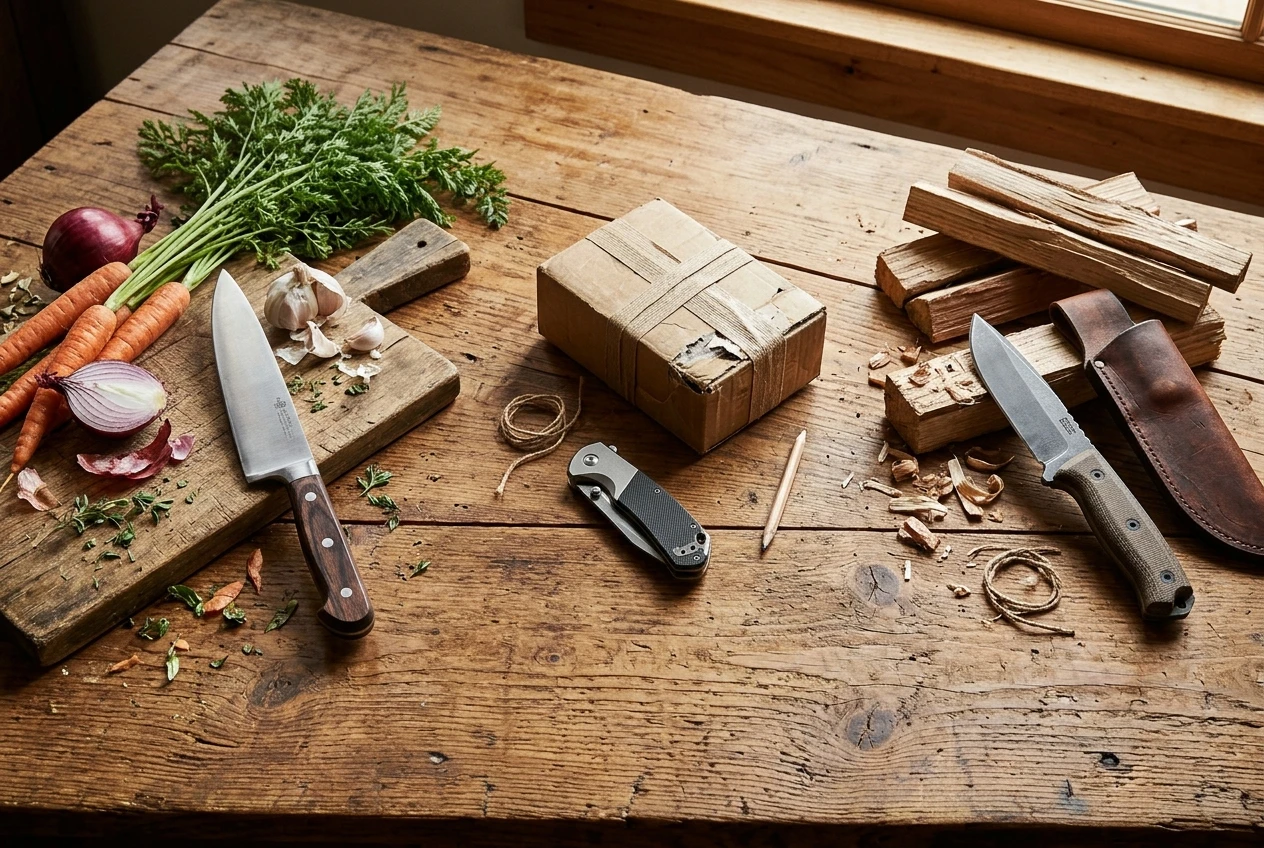
Different tasks call for different knives. From food preparation to everyday cutting and outdoor chores, choosing the right blade makes the work safer, easier, and more efficient.
Consider three very different knives.
The Chef’s Knife
A good chef’s knife prioritizes efficient cutting, comfortable handling, adequate knuckle clearance, and control during repeated food preparation.
Its blade geometry and balance should support slicing, chopping, and other kitchen tasks.
The Everyday-Carry Pocketknife
A good everyday-carry knife emphasizes portability, practical blade geometry, secure handling, and reliable construction.
A compact knife may be more useful for opening packages and performing routine cutting tasks than a much larger, heavier design.
The Outdoor Knife
An outdoor knife may prioritize durability, corrosion resistance, secure grip, and performance under challenging conditions.
Depending on its intended use, it may sacrifice some slicing efficiency for additional structural robustness.
Trying to judge all three knives by the same standard would miss the point.
Their designs reflect different priorities.
9. Does a Higher Price Mean a Better Knife?
Not necessarily.
Price can reflect material costs, manufacturing precision, labor, quality control, design, branding, distribution, and country of manufacture.
More expensive knives may offer meaningful improvements in materials, craftsmanship, or consistency.
But price alone cannot establish whether those improvements matter to a particular user.
A modestly priced knife with appropriate steel, sound heat treatment, comfortable ergonomics, and good geometry can be an excellent tool.
Conversely, an expensive knife with impressive specifications may be poorly suited to your needs.
The goal is not to purchase the most prestigious knife.
It is to recognize which qualities matter and decide what they are worth to you.
10. A Practical Checklist for Evaluating a Knife
Before buying a knife, ask yourself:
- Purpose: What tasks will I actually use it for?
- Geometry: Is the blade shaped and ground appropriately for those tasks?
- Steel: Does the material offer a sensible balance of edge retention, toughness, corrosion resistance, and maintenance?
- Heat treatment: Is there reason to trust the manufacturer’s quality control?
- Balance: Does the knife feel controlled and natural in my hand?
- Ergonomics: Is the handle comfortable and secure?
- Construction: Are the components properly fitted and assembled?
- Edge: Is the cutting edge suitable for the intended work?
- Maintenance: Can I realistically sharpen and care for this knife?
- Value: Am I paying for useful performance or features I don’t need?
You don’t have to become a metallurgist or professional bladesmith to recognize a good knife.
But understanding these principles makes it easier to separate genuine quality from marketing.
Final Thoughts: Quality Is a Matter of Harmony
A truly good knife is more than a collection of impressive specifications.
Steel, geometry, balance, handle design, construction, and craftsmanship must work together.
A superb blade attached to an uncomfortable handle is an incomplete design. An expensive steel with poor heat treatment cannot deliver its potential. A perfectly balanced knife with inappropriate geometry may still struggle with its intended task.
The best knives achieve something more subtle.
Their individual qualities complement one another so effectively that the user stops thinking about the tool and concentrates on the work.
And perhaps that is the finest measure of a good knife:
It does its job so naturally that you hardly notice the knife at all.
Get Knifed — Where the Edge Matters.