
Understanding the Parts, Design, and Function of a Blade
A knife may be one of humanity’s oldest tools, but its design is far more sophisticated than it first appears. What looks like a simple blade attached to a handle is actually a carefully engineered combination of shapes, angles, materials, and structural elements.
From the chef’s knife in your kitchen to the folding knife in your pocket, every feature serves a purpose. The curve of the cutting edge, the thickness of the spine, the construction of the handle, and even the location of the knife’s balance point influence how it performs.
Understanding knife anatomy is the first step toward recognizing quality craftsmanship, selecting the right tool, and using it effectively.
Let’s examine the parts of a knife, beginning with the blade itself.
1. The Blade: Where Form Meets Function
The blade is the working portion of the knife. Although blade designs vary enormously, most share several fundamental features.
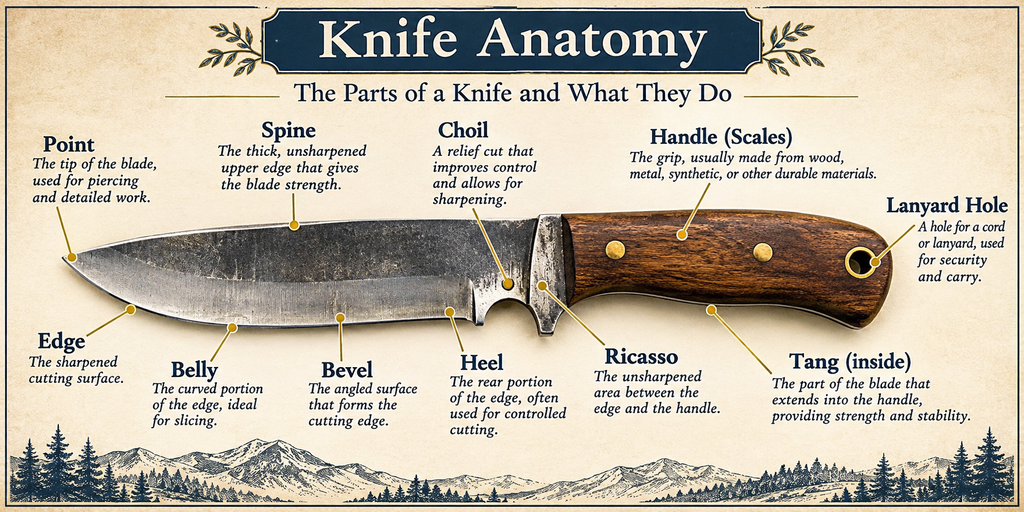
The Point and Tip
The point is the location where the cutting edge and the upper profile of the blade converge. The tip refers to the region immediately behind that point.
Some knives have narrow, sharply defined points designed for precision work. Others have rounded or less prominent points suited to tasks where puncturing is unnecessary or undesirable.
A drop-point knife, for example, has a spine that curves downward toward the point, producing a versatile blade shape commonly found on outdoor and everyday-carry knives.
A chef’s knife, by contrast, generally has a broad blade with a pointed front section useful for detailed food preparation.
The Cutting Edge
The cutting edge is the sharpened portion of the blade that separates material.
Not all cutting edges are straight. Some curve, some are serrated, and others combine different edge profiles.
A plain edge offers a continuous cutting surface and is relatively straightforward to maintain. Serrated edges use a series of teeth that can be particularly effective when cutting materials with tough outer surfaces.
The appropriate edge depends on what the knife is intended to cut.
The Belly
The belly is the curved portion of the cutting edge, usually toward the front of the blade.
A pronounced belly provides a longer curved cutting surface, useful for slicing and rocking motions.
Many chef’s knives have a generous belly that allows the cook to rock the blade against a cutting board while chopping vegetables and herbs.
Some utility knives have comparatively straight edges, making them better suited to controlled, linear cuts.
The Spine
The spine is the upper, generally unsharpened portion of a conventional single-edged blade.
Its thickness contributes to the blade’s stiffness, strength, and weight.
A thick spine may provide greater rigidity, while a thinner blade can move more easily through certain materials.
However, thickness alone does not determine strength. Blade geometry, steel properties, and heat treatment all influence performance.
The Heel
The heel is the rear portion of the cutting edge, closest to the handle.
On a chef’s knife, this area is frequently used for cutting firmer ingredients because it is positioned near the user’s hand, allowing greater control.
On some knives, the heel is clearly defined; on others, it blends almost seamlessly into the rest of the cutting edge.
The Bevel and Grind
A bevel is an angled surface formed as the blade narrows toward its cutting edge.
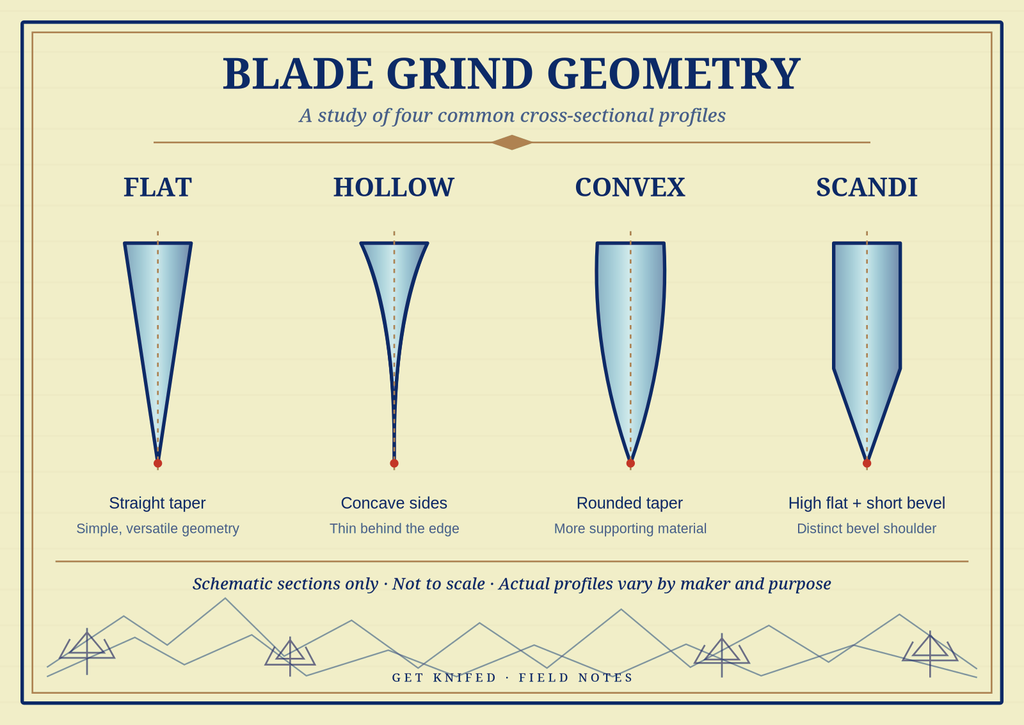
The grind describes the overall geometry created by shaping the blade’s cross-section.
Common grinds include flat, hollow, convex, and Scandinavian grinds.
Each has different advantages. A thin hollow grind can produce excellent slicing performance, while a Scandinavian grind is often associated with woodworking and outdoor utility knives.
The final cutting edge may have its own smaller bevel, commonly called the edge bevel.
The Ricasso and Choil
The ricasso is an unsharpened section of blade between the cutting edge and the handle or guard, found on some knives.
A choil is a notch or recess near the base of the blade. Depending on its design, it may provide clearance for sharpening or accommodate a finger.
These features are not present on every knife, and their terminology can vary between knife-making traditions.
2. The Tang: The Hidden Foundation
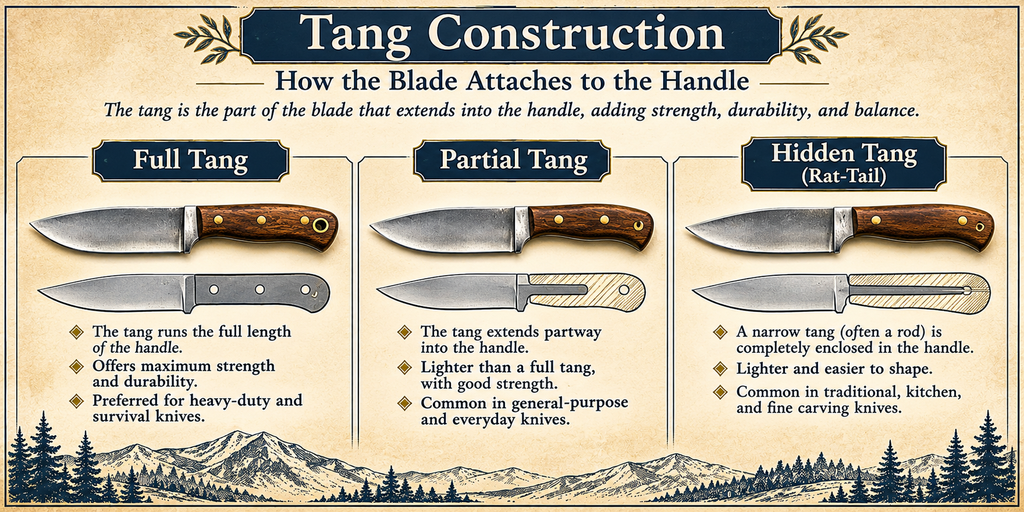
The tang is the portion of the blade’s metal that extends into the handle.
Although often concealed, it plays an important role in the knife’s construction, balance, and durability.
Full Tang
A full-tang knife has a tang extending through most or all of the handle’s length and often following much of its outline.
On many full-tang knives, handle scales are attached to either side of the metal with rivets, pins, or screws.
This construction is common on fixed-blade outdoor knives and many Western-style kitchen knives.
Full-tang construction can provide excellent durability, although it is not automatically superior to every other handle design.
Partial Tang
A partial tang extends only partway into the handle.
Partial-tang knives can be perfectly suitable for their intended tasks when properly designed and constructed.
Hidden Tang
A hidden tang is enclosed within the handle material rather than exposed along its sides.
Many traditional Japanese kitchen knives and Scandinavian outdoor knives use hidden-tang construction.
A well-made hidden-tang knife can be remarkably strong, light, and comfortable.
The quality of the design and construction matters more than simply whether the tang is visible.
3. The Handle: Control, Comfort, and Safety
A knife’s handle is more than a place to grip it. Its shape, dimensions, texture, and material affect comfort and control.
A poorly designed handle can make even an excellent blade awkward to use.
Handle Scales
Scales are separate pieces of handle material attached to either side of a tang.
They may be made from wood, synthetic composites, metal, or other materials.
Wood offers a traditional appearance and can feel warm in the hand. Synthetic materials such as G10 and Micarta are popular because of their durability and resistance to environmental conditions.
Pins, Rivets, and Screws
These fasteners secure handle components to the tang.
Some knives use visible metal rivets, while others employ removable screws or concealed fastening systems.
Their presence alone is not a guarantee of quality. Fit, finish, and construction are more important.
Ergonomics
A good handle should allow the user to maintain control without excessive gripping force.
Handle thickness, contour, surface texture, and balance all influence comfort.
Hand size matters, too. A knife that feels natural to one person may be uncomfortable for another.
This is one reason handling a knife before purchasing it can be so valuable.
4. Bolsters, Guards, and Pommels
Some knives incorporate additional structural features between the blade and handle or at the handle’s end.
The Bolster
A bolster is a thickened section, often located where the blade meets the handle.
On some kitchen knives, it adds weight and contributes to balance. It may also provide a transition between the blade and handle.
Not all knives have bolsters, and some modern kitchen knives deliberately omit a full bolster to make sharpening easier.
The Guard
A guard is a projection or barrier near the handle that helps prevent the hand from sliding toward the cutting edge.
Guards vary considerably in size and design.
Many kitchen knives have little or no distinct guard, relying instead on handle shape, grip technique, and careful use.
The Pommel
The pommel is the end of the handle opposite the blade.
On some knives, it is simply the handle’s end cap. On others, it may contribute to balance or serve a structural purpose.
Not every knife has a separately constructed pommel.
5. Blade Geometry: Why Shape Matters
Two knives made from the same steel can perform very differently.
One reason is blade geometry.
A thin blade generally encounters less resistance when passing through food or other suitable materials. A thicker blade may provide additional stiffness and resistance to bending.
The angle of the cutting edge also matters.
A relatively acute edge can slice efficiently but may be more vulnerable to damage under demanding use. A more obtuse edge can offer greater durability at the expense of some cutting efficiency.
These relationships are influenced by steel composition, heat treatment, blade thickness, and intended use.
There is no single ideal geometry for every knife.
A kitchen knife intended for delicate slicing has different requirements from a woodworking knife or a rugged outdoor utility blade.
Good design involves choosing the appropriate compromises.
6. Balance: How a Knife Feels in the Hand
A knife’s balance point is the location where its weight is evenly distributed.
On many kitchen knives, this point lies near the junction of the blade and handle, although designs vary.
A blade-heavy knife may feel useful for certain chopping tasks, while a handle-heavy knife may feel more controlled during delicate work.
Neither arrangement is universally better.
Balance is partly a matter of intended function and partly a matter of personal preference.
A knife’s overall weight, handle geometry, and grip position are just as important to how it feels in use.
7. Putting It All Together
Understanding knife anatomy changes the way we look at this ancient tool.
The blade is no longer simply a piece of sharpened steel. Its point, edge, belly, spine, and grind reveal clues about its intended purpose.
The tang and handle tell us about construction, comfort, and durability.
The bolster, guard, and balance point help explain how the knife behaves in the hand.
Perhaps the most important lesson is that there is no perfect knife for every task.
A well-designed knife is one whose materials, geometry, construction, and ergonomics work together to fulfill its intended purpose.
And once you understand those elements, you’re much better prepared to answer the question every first-time knife buyer eventually faces:
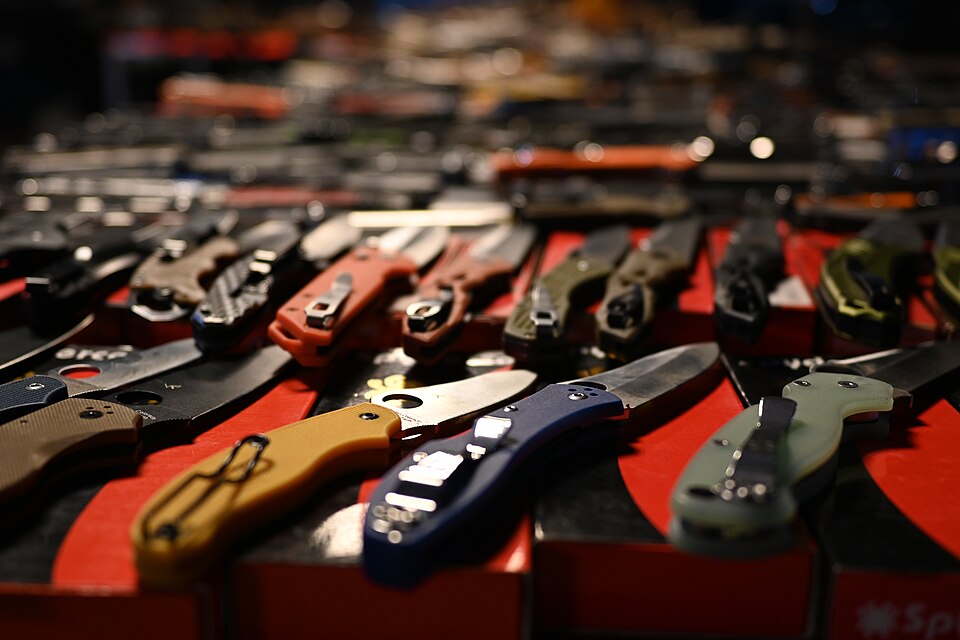
Image credit: “A Display of Assorted Folding Pocket Knives,” by PattayaPatrol, via Wikimedia Commons. Licensed under CC BY-SA 4.0.

Which knife is right for me?
That’s where we’ll go next.