
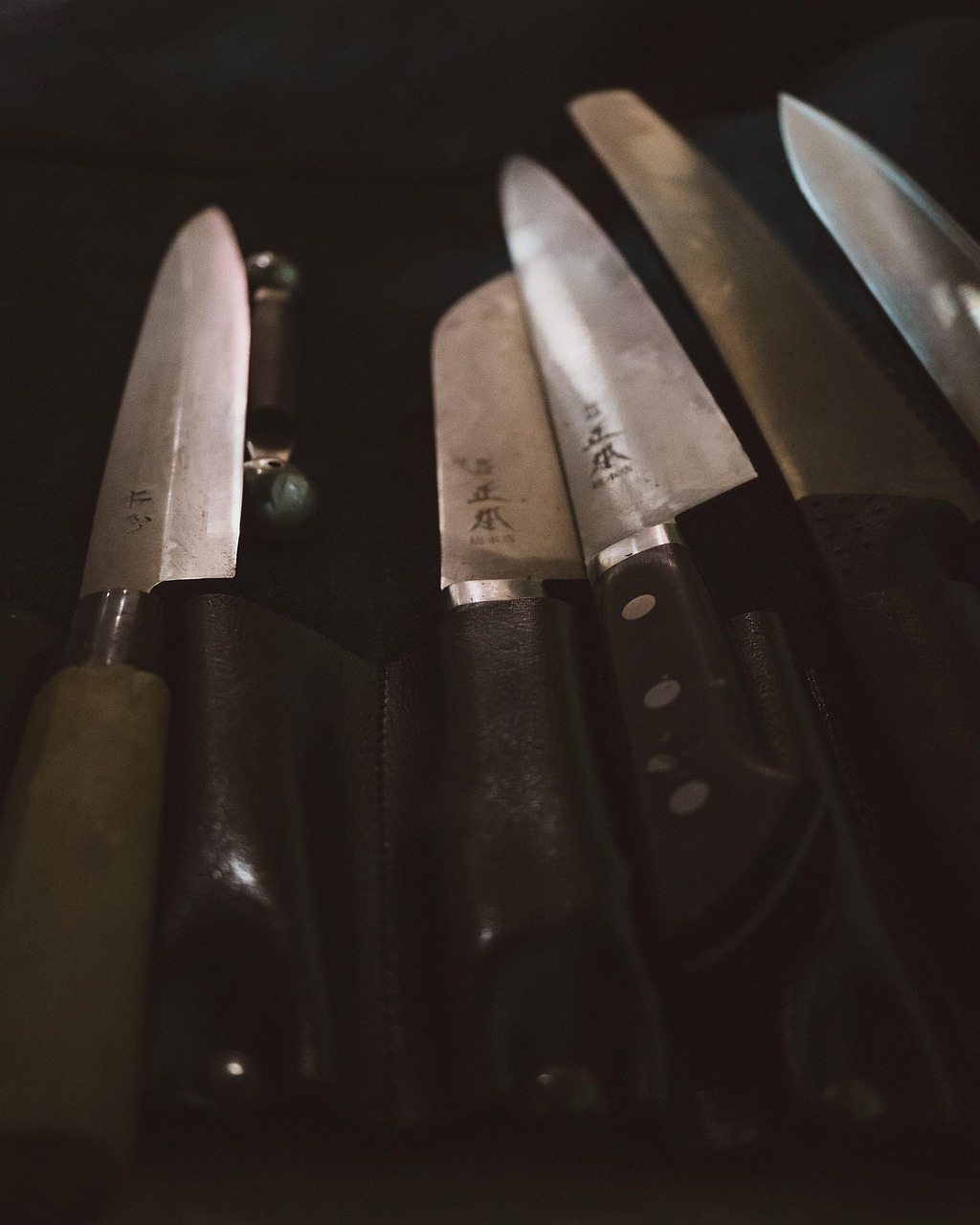
Before the wheel, before the written word, and long before the first sword was forged, there was the knife.
Imagine a world without knives. No neatly sliced bread, no carefully prepared vegetables, no finely carved furniture, and no surgeon’s scalpel. Even the simplest tasks would become surprisingly difficult.
The knife is so familiar that we rarely stop to consider its extraordinary history. Yet this humble tool has accompanied humanity through nearly every stage of technological development.
From the first sharp-edged stones to the precision-forged blades of today, the knife tells a story of human ingenuity, survival, artistry, and the endless pursuit of a better cutting edge.
Before Metal: The First Cutting Edges
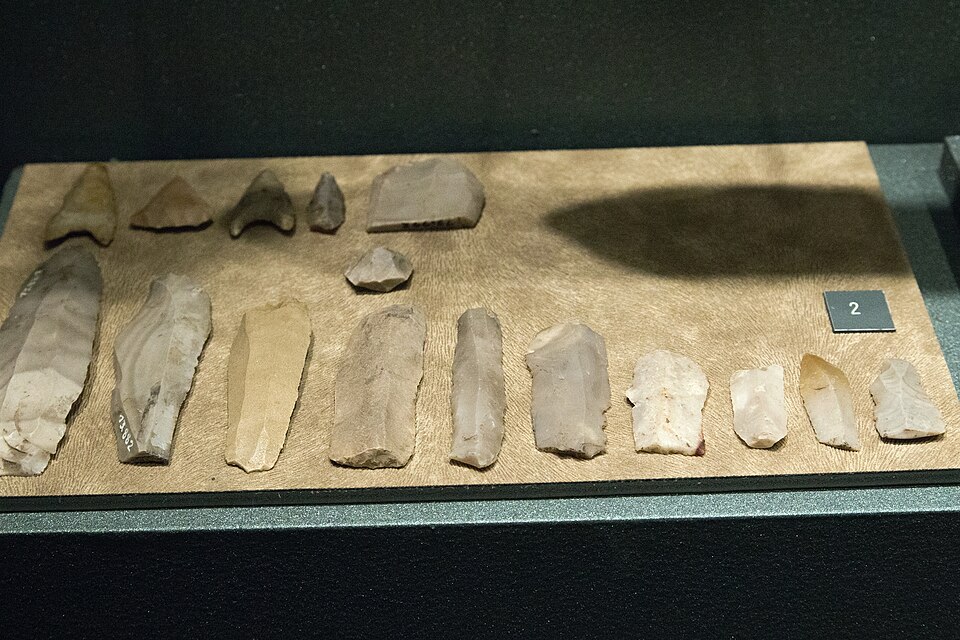
Neolithic flint blades on display at the City of Prague Museum. Photograph by Zde, licensed under CC BY-SA 4.0.
Long before humans learned to work metal, our ancestors discovered that certain stones could be broken to produce remarkably sharp edges.
Some of the earliest widely accepted evidence of deliberate stone-tool manufacture comes from Lomekwi 3 in Kenya, where archaeologists have identified tools dating to approximately 3.3 million years ago.
These ancient implements were not knives in the modern sense. Many were heavy, roughly shaped stones used for pounding or cutting. But they marked an extraordinary development: the ability to deliberately modify a natural material to accomplish a task.
Later, stoneworkers developed increasingly sophisticated methods of producing sharp flakes from carefully selected rocks.
Flint, chert, and obsidian became particularly valuable because of the way they fracture.
Obsidian, a naturally occurring volcanic glass, can produce an edge extraordinarily fine and sharp. Even today, specialized obsidian blades are used in some experimental and niche cutting applications, although their brittleness limits their usefulness.
For prehistoric communities, sharp stone tools made it easier to butcher animals, process hides, cut plant materials, and shape wood.
The knife was not simply a convenience. It was a tool that helped our ancestors make use of the world around them.
The Bronze Age: A New Material Changes Everything
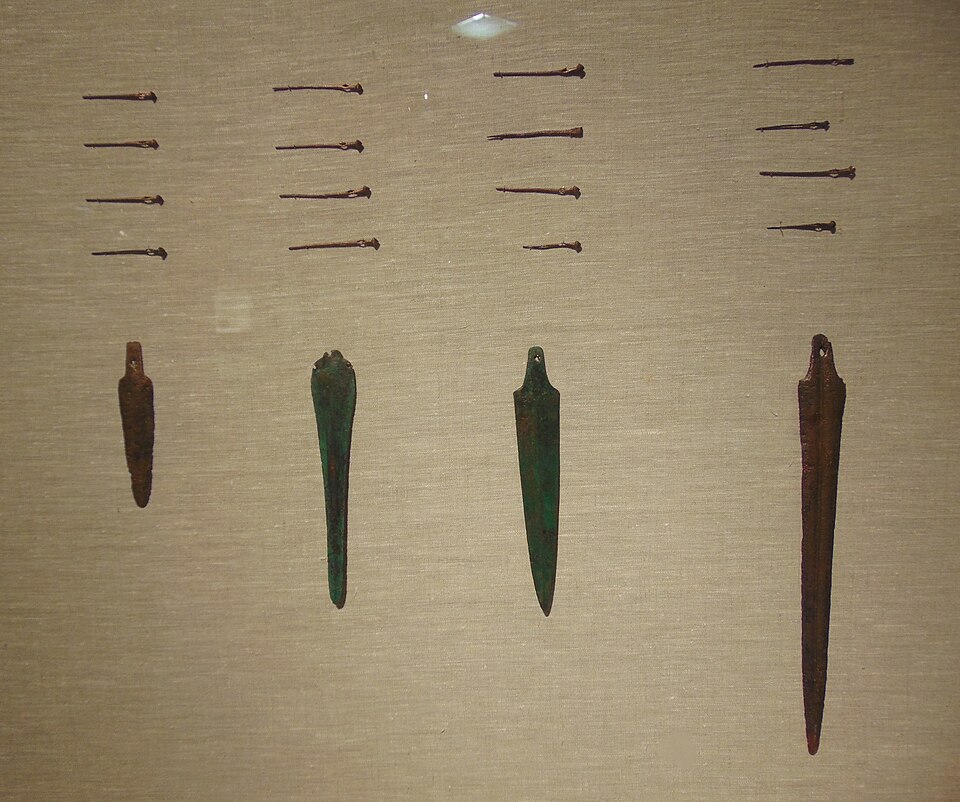
Bronze Age daggers, a sword, and brooches from Kakheti, Georgia, dating to approximately 2000–1500 BC. Sighnaghi Museum. Photograph by Kober, CC BY-SA 4.0.
For millions of years, stone remained an essential cutting material. Then, in different regions and at different times, humans began experimenting with metals.
Early metalworkers discovered that copper could be hammered into useful shapes. Unfortunately, pure copper was relatively soft, making it less than ideal for many cutting tools.
The development of bronze, typically an alloy of copper and tin, offered important advantages.
Bronze could be cast into complex shapes and, with suitable working and alloy composition, produced durable cutting implements.
By the Bronze Age, metal knives had become familiar objects in many societies.
Some were practical tools for preparing food, working leather, or performing agricultural tasks. Others were elaborate objects decorated with intricate designs, suggesting wealth, status, or ceremonial importance.
The knife was becoming something more than a tool of necessity.
It could also be an expression of identity and craftsmanship.
The Iron Age: The Rise of the Blacksmith
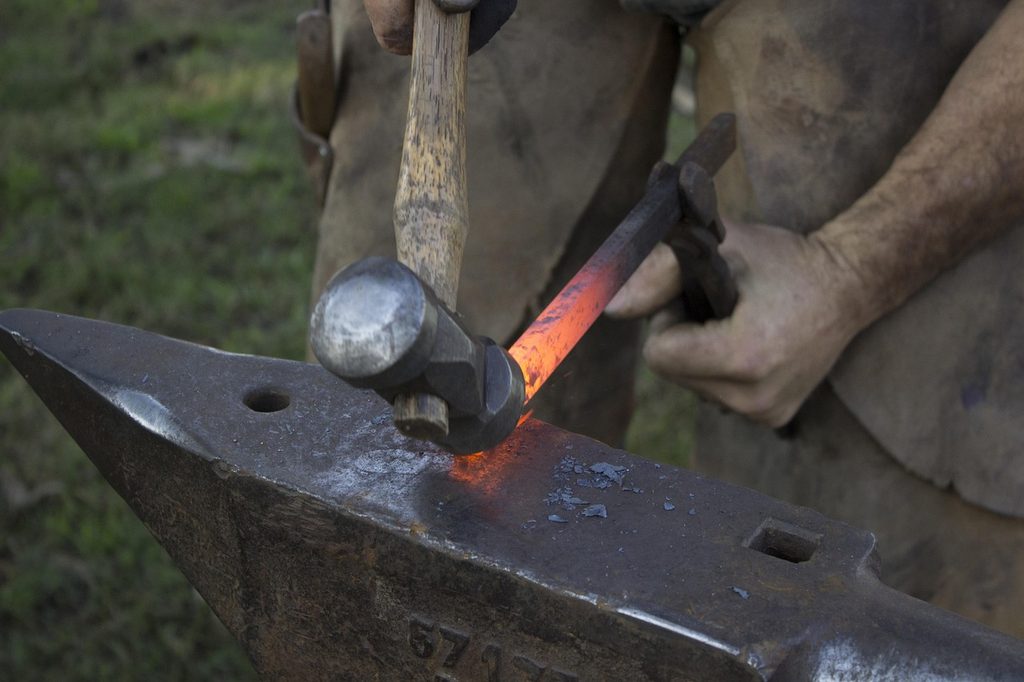
A blacksmith shapes heated metal on an anvil, demonstrating a forging technique whose roots stretch back thousands of years.
Iron introduced another transformation.
Although early iron was not automatically superior to well-made bronze, the development of ironworking eventually opened the door to more versatile and increasingly sophisticated blades.
Iron could be heated, hammered, shaped, and repaired. As smiths gained greater control over their materials, they learned how carbon affected the properties of iron.
The development of steel—iron containing a controlled amount of carbon—made possible blades that could be hardened while retaining useful toughness.
Heat treatment became one of the great secrets of the blade maker’s craft.
A blacksmith could heat a suitable steel blade and cool it rapidly, a process known as quenching, to increase its hardness. Tempering afterward could reduce brittleness and produce a more practical balance between hardness and toughness.
These processes required skill, observation, and experience.
A poorly treated blade might bend too easily or break under stress. A well-made blade could serve its owner for years.
As ironworking spread and evolved, knives became increasingly specialized for cooking, woodworking, agriculture, hunting, and countless other occupations.
The blacksmith became an indispensable member of many communities.
The Art of Steel: When Utility Becomes Craftsmanship
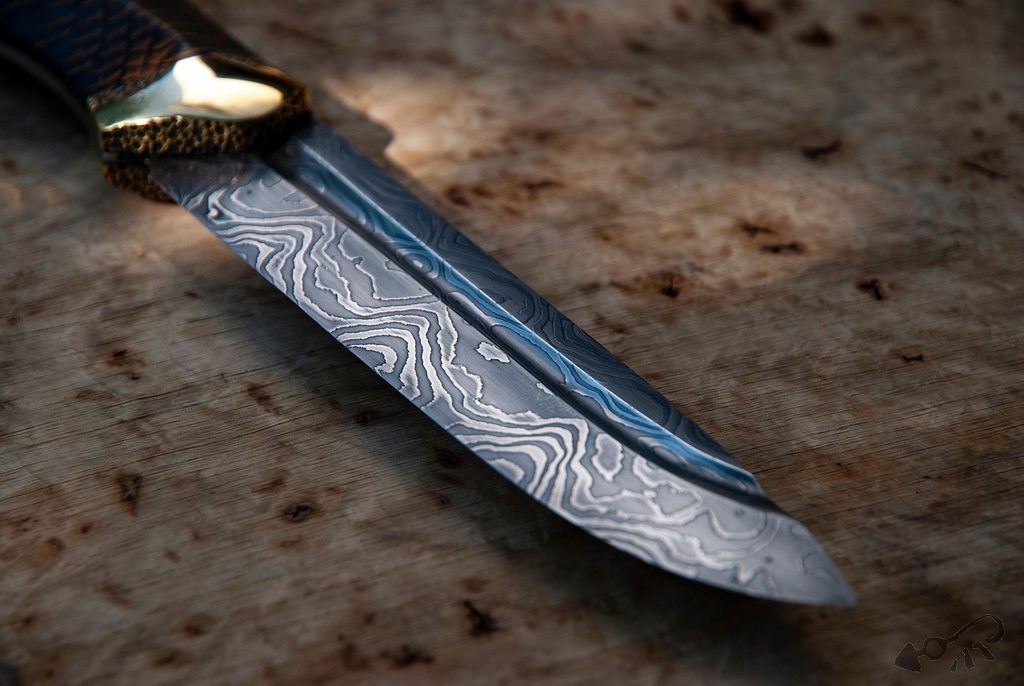
The distinctive flowing patterns of a Damascus-style steel blade demonstrate how craftsmanship can transform an everyday cutting tool into a work of art.
Over the centuries, blade makers developed traditions that combined practical engineering with remarkable artistry.
In parts of the Middle East, Central Asia, and South Asia, crucible steels became renowned for their distinctive properties. Some historical blades made from these steels displayed beautiful surface patterns associated with what is often called wootz or crucible Damascus steel.
In Europe, smiths developed techniques such as pattern welding, joining different pieces of iron and steel to create blades with particular structural and decorative characteristics.
These historical processes should not be confused with every modern knife marketed as Damascus steel. Today, the term frequently refers to layered, pattern-welded steels produced primarily for their appearance and craftsmanship.
Regardless of the method, the underlying challenge remained the same.
A good knife needed an edge capable of cutting effectively, enough toughness to withstand its intended use, and a design that felt secure and comfortable in the hand.
Those requirements still guide knife makers today.
Knives Around the World: Different Cultures, Different Blades
As civilizations developed, knives evolved to meet the particular needs of their users.
The diversity is astonishing.
Japan: Precision and Specialization
Japanese knife-making traditions were shaped by centuries of metalworking, including the production of swords and specialized woodworking tools.
Japanese kitchen knives eventually developed into highly refined instruments suited to particular food-preparation tasks.
The yanagiba, for example, is traditionally used for slicing raw fish. The deba is designed for tasks associated with preparing fish, while the nakiri is intended primarily for cutting vegetables.
Many traditional Japanese kitchen knives use a single-bevel cutting geometry, although numerous modern Japanese designs employ double-bevel edges.
Japanese blades are often associated with careful sharpening, precise cutting geometry, and specialized craftsmanship.
Germany: Strength and Versatility
The German city of Solingen has been associated with blade manufacturing for centuries.
Its reputation grew from a long tradition of metalworking, skilled craftspeople, and the production of cutting tools.
German kitchen knives became especially well known for their versatile designs.
Many traditional German chef’s knives feature a curved cutting edge, a substantial handle, and a construction intended to accommodate a broad range of kitchen tasks.
Manufacturers such as Wüsthof and Zwilling have helped make German cutlery familiar in kitchens around the world.
The distinction between German and Japanese knives is not absolute, however. Modern manufacturers frequently combine design features from both traditions.
Scandinavia: The Practical Outdoor Knife
In Scandinavia, knives have long played an important role in woodworking, fishing, hunting, and outdoor life.
The Finnish puukko is a particularly recognizable example.
Typically featuring a relatively short fixed blade and a straightforward handle, the puukko is valued for controlled cutting and woodcraft.
Its design illustrates an important principle: a knife does not need to be elaborate to be exceptionally useful.
Sometimes simplicity is the highest expression of craftsmanship.
The Modern Knife: Science Meets Tradition
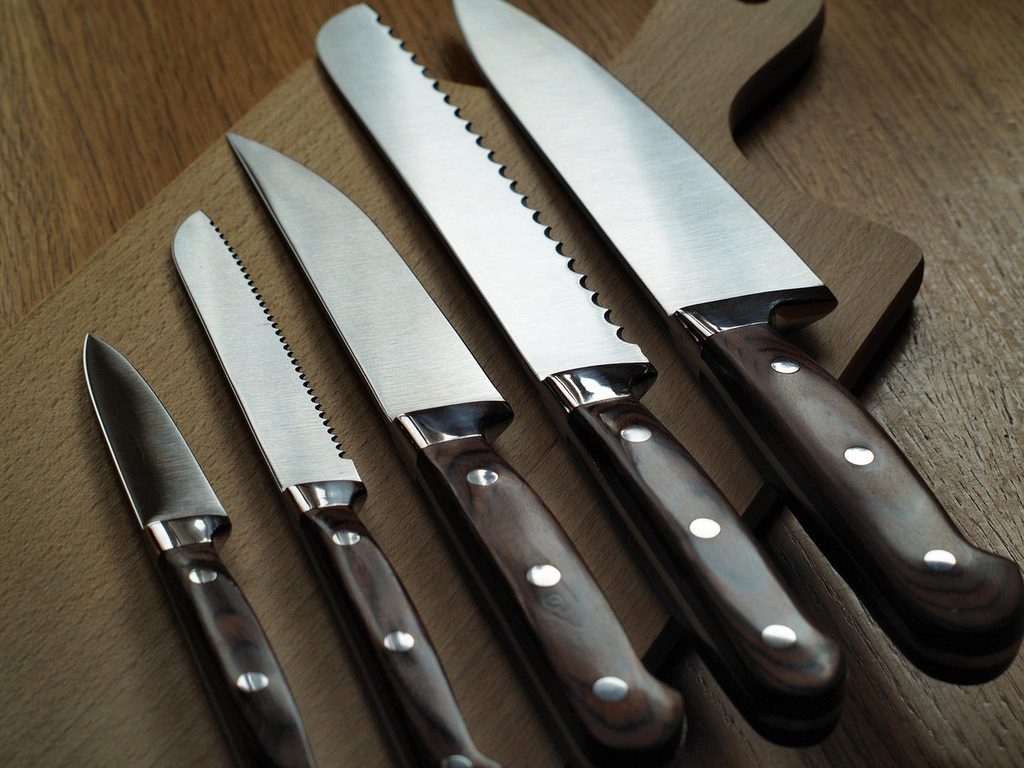
Modern kitchen knives combine centuries of traditional blade design with advances in steel production, heat treatment, and precision manufacturing.
Today’s knife makers have access to materials and manufacturing techniques that earlier generations could scarcely have imagined.
Stainless steels containing sufficient chromium offer improved resistance to corrosion. High-carbon steels remain popular for their particular sharpening and performance characteristics, although they generally require more attention to prevent rust.
Modern powder metallurgy allows manufacturers to produce certain high-performance steels with carefully controlled compositions and microstructures.
Computer-controlled machining, precision grinding, and advanced heat-treatment equipment have transformed large-scale production.
Yet traditional craftsmanship has not disappeared.
Across the world, independent knife makers continue to forge, grind, polish, and finish blades by hand.
Some specialize in kitchen knives. Others create pocketknives, woodworking tools, or traditional regional designs.
For collectors and enthusiasts, a handmade knife may represent far more than its practical function.
It can embody the knowledge, judgment, and aesthetic vision of the person who made it.
What Makes a Good Knife?
After thousands of years of experimentation, one question remains surprisingly difficult to answer.
What makes a knife good?
Is it the hardness of the steel? The sharpness of the edge? The shape of the blade? The quality of the handle?
The answer depends on what the knife is intended to do.
A delicate kitchen slicer and a rugged woodworking knife may require very different properties.
An exceptionally hard blade may retain its edge well under appropriate conditions but may also be more vulnerable to chipping if its geometry and toughness are poorly matched to the task.
A softer blade may require more frequent sharpening but can sometimes be easier to maintain.
Even the most expensive steel cannot compensate for uncomfortable ergonomics, poor construction, or an unsuitable design.
The best knife is not necessarily the most expensive, the hardest, or the sharpest straight out of the box.
It is the one whose materials, geometry, construction, and handling are well suited to its intended purpose.
A Tool That Changed the World
The history of the knife is, in many ways, the history of human problem-solving.
Our ancestors began with sharp fragments of stone. Over countless generations, they experimented with copper, bronze, iron, and steel.
They learned to shape materials, control heat, improve edges, and adapt designs to increasingly specialized tasks.
Today, we can purchase an inexpensive kitchen knife made with manufacturing precision that would have astonished an ancient blacksmith.
And yet the fundamental purpose remains unchanged.
A knife is a tool that concentrates force along a narrow edge, allowing us to cut, shape, prepare, and create.
From the prehistoric stoneworker to the modern master bladesmith, the same basic human impulse connects them all: the desire to make something that works better.
The knife may be one of humanity’s oldest tools.
It is also one of our most enduring.
Coming Next: The Anatomy of a Knife
What exactly separates an ordinary knife from an exceptional one?
In our next article, The Anatomy of a Knife: More Than Just a Blade, we’ll explore blade geometry, steel, tangs, handles, and the design details that determine how a knife performs.
Because when it comes to knives, the edge matters.
Get Knifed — Where the Edge Matters.