
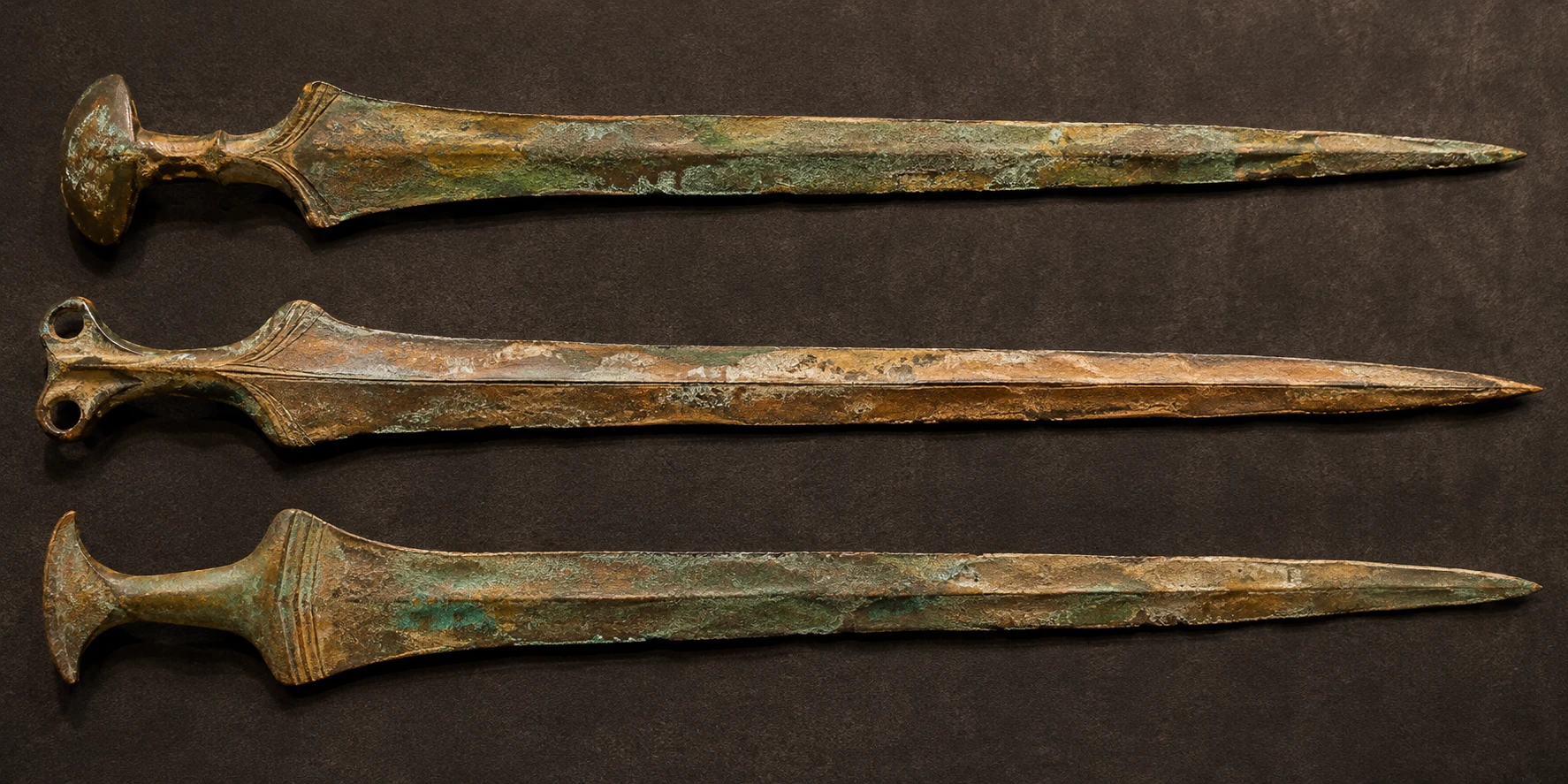
From the bronze swords of ancient kingdoms to the elegant blades of Japan, the curved sabers of Central Asia, and the formidable swords of medieval Europe, the sword tells a remarkable story of human ingenuity.
For thousands of years, the sword has been far more than a weapon.
It has represented authority, courage, craftsmanship, wealth, ceremony, and cultural identity. Kings carried swords as symbols of power. Warriors depended on them in battle. Craftsmen devoted years to mastering the complex relationship between fire, metal, and the human hand.
And although swords developed independently or through cultural exchange in different parts of the world, their makers faced many of the same challenges.
How could a blade be made long enough to reach an opponent, strong enough to survive impact, and light enough to wield effectively?
How could metal be shaped to hold a sharp edge without becoming dangerously brittle?
The answers varied across centuries and civilizations, producing an extraordinary diversity of sword designs.
Some were straight and double-edged. Others curved gracefully toward their points. Some were intended primarily for cutting, others emphasized thrusting, and many were designed to do both.
To understand the history of the sword is to explore the history of metallurgy, trade, warfare, craftsmanship, and the people who shaped them.
Our journey begins long before the first steel blades appeared.
1. The Bronze Age: When the Sword Was Born
The earliest swords emerged during the Bronze Age, when metalworkers learned to produce blades longer than ordinary daggers. The change sounds small, but it was a real technical leap. A longer blade demanded more metal, more careful casting, and a design that would not bend or break the first time it struck something solid.
Copper alone was generally too soft for many demanding applications. But combining copper with tin, or sometimes other alloying elements, produced bronze, a material that could be cast into useful shapes and subsequently worked to improve its properties. Smiths poured molten metal into carefully prepared molds, then hammered the edges of the cooled blade. Hammering hardened the metal and gave the edge a sharper, more durable profile.
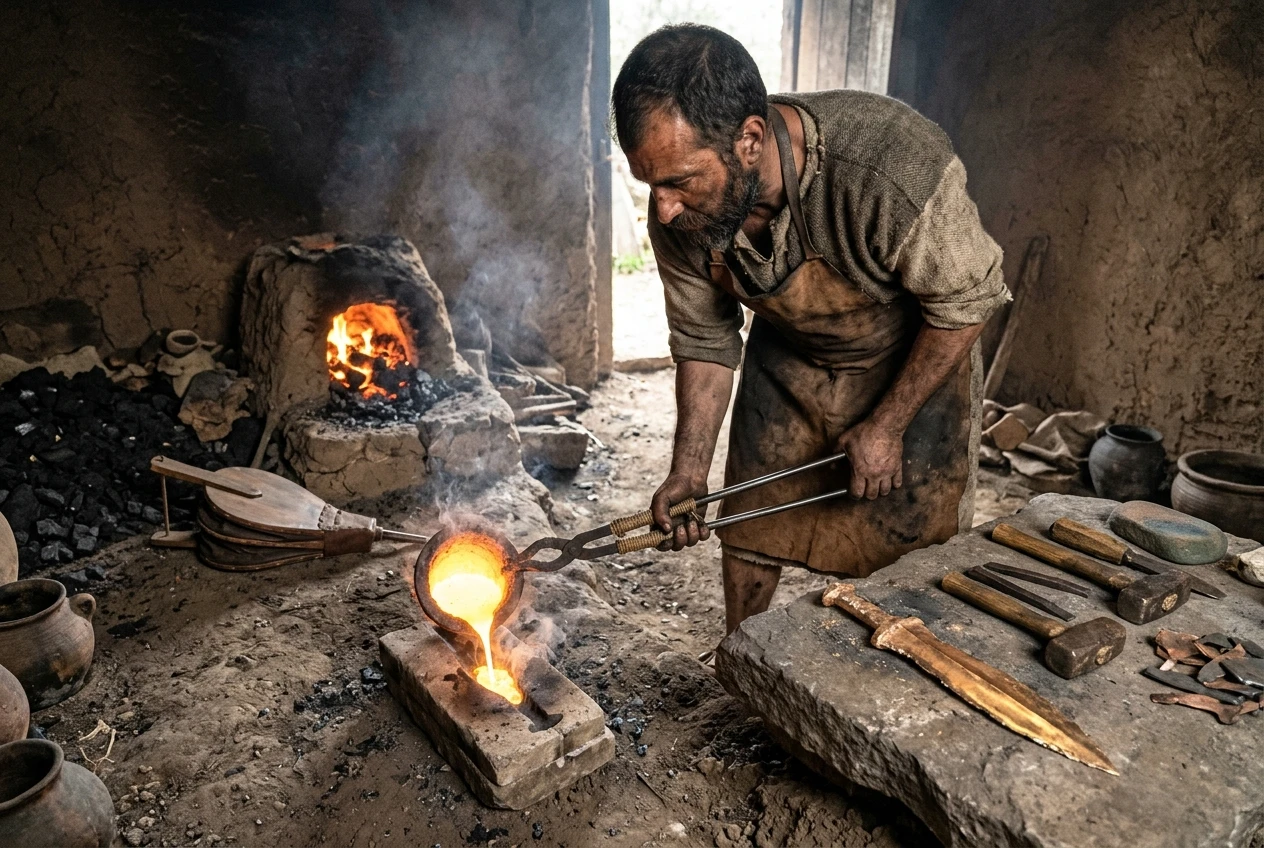
Artist’s reconstruction of Bronze Age metalworking. Ancient craftspeople poured molten copper alloys into molds, then refined and finished the cast blades.
Bronze still imposed limits. It is more likely to bend than to snap, and the longer the blade, the greater the risk of deformation. Early makers had to balance length, thickness, and weight, and the way a blade was joined to its hilt was often a point of weakness. Much of the early evolution of the sword was an effort to solve these problems.
Artist’s reconstruction of a Roman gladius resting on a legionary shield (scutum), alongside a Roman helmet. The gladius was a principal close-combat weapon of Roman infantry during the early Imperial period. ⚔️
Early sword-like blades appeared by the late fourth millennium BCE, with swordmaking traditions developing further across different regions during the following millennia.
Some of the earliest known swords were discovered at Arslantepe, in present-day Türkiye. Dating to approximately 3300–3000 BCE, these remarkable metal blades were made from arsenical copper rather than true tin bronze, and some were decorated with silver inlay. They were found in a context linked to the elite, which shows how early swordmaking was already associated with emerging political power and high status. These weapons were as much symbols of authority as tools of combat.
By the second millennium BCE, recognizable bronze swords were established in several societies. Casting techniques had improved, blades had grown more reliable, and regional styles were beginning to take shape.
The Swords of the Aegean
In the ancient Aegean world, Minoan and Mycenaean craftsmen produced elegant bronze swords, including long, slender examples and later shorter designs.
Some early Aegean swords were primarily suited to thrusting, while later designs offered different combinations of cutting and thrusting capabilities.
Their forms reflected the fighting methods, materials, and manufacturing techniques of their time.
Bronze Swords in China
Bronze swordmaking also developed in ancient China.
During the late Zhou period, particularly the Spring and Autumn and Warring States eras, Chinese bronze swords achieved remarkable sophistication.
The famous Sword of Goujian, associated with the fifth century BCE and discovered in Hubei Province, demonstrates the skill of ancient Chinese metalworkers.
Its carefully finished bronze blade and distinctive decoration have made it one of the most celebrated surviving ancient swords.
Bronze swords were not merely crude predecessors of iron weapons. In skilled hands, bronze could produce highly effective blades.
But another material would eventually transform swordmaking.
2. The Iron Age: A New Material Changes Everything
Iron gradually replaced bronze for many weapons and tools across different regions, although the transition occurred at different times.
Iron was not automatically superior in every form.
Early wrought iron could be relatively soft, and producing consistently useful blades required considerable skill.
The real transformation came through increasingly sophisticated control of carbon content and heat treatment.
Iron containing suitable amounts of carbon could be made into steel, offering combinations of hardness, strength, and toughness that opened new possibilities for sword design.
Why Steel Mattered
Steel allowed bladesmiths to develop cutting edges that could be hardened while maintaining sufficient toughness for practical use.
But making a good steel sword was never simply a matter of heating iron until it glowed.
The smith needed to understand, often through generations of practical experience, how the material behaved during forging, cooling, and reheating.
Different cultures developed different approaches to producing and working iron and steel.
Some combined materials of differing carbon content. Others refined their smelting and forging techniques. In certain regions, crucible steel production became especially important.
These developments did not occur in a single place or follow one universal path.
The history of the sword is also a history of knowledge traveling between peoples.
3. Ancient Europe: From the Greek Xiphos to the Roman Gladius
In ancient Greece, the xiphos was a relatively short, double-edged sword associated with Greek warriors.
Its leaf-shaped blade, found in various examples, could serve for both cutting and thrusting.
Greek soldiers generally relied heavily on spears, but the sword provided an important secondary weapon.
The Romans developed several distinctive sword traditions.
The Roman Gladius
The gladius is among the most recognizable swords of antiquity.
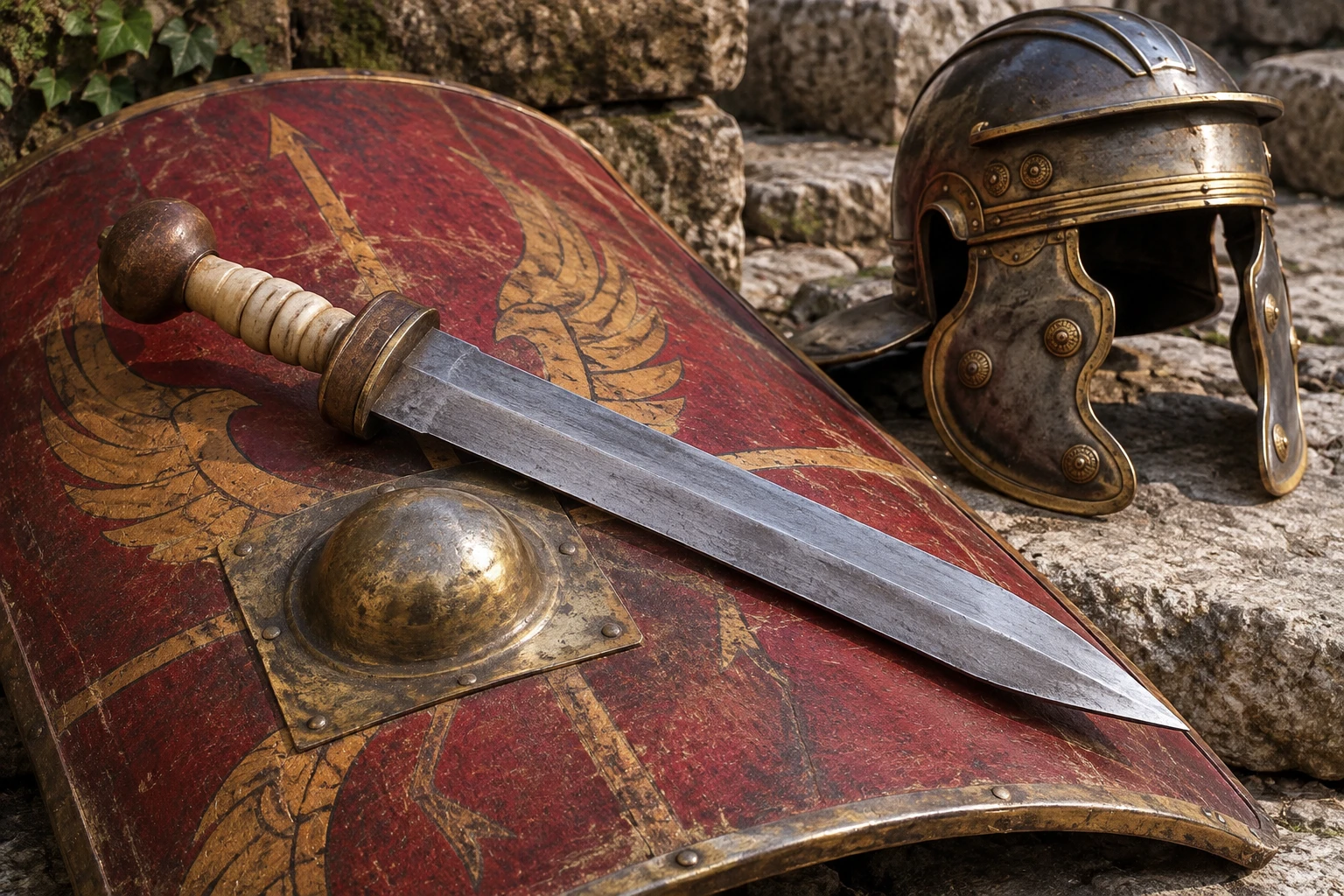
Associated particularly with Roman infantry, it was a relatively short sword whose design evolved over time.
Different forms varied in length, blade profile, and point shape.
The gladius was well suited to close fighting, including thrusting, although it was also capable of cutting.
Its effectiveness depended not simply on the blade but on the training, formations, shields, and tactics of Roman soldiers.
The Roman Spatha
Another important Roman sword was the spatha, a longer blade associated initially with cavalry and later used more broadly.
Longer swords of this general tradition influenced subsequent European sword development.
As the Roman world changed and new kingdoms emerged, sword designs continued to evolve.
The sword would become one of the most powerful symbols of medieval Europe.
4. Northern Europe: Viking-Age Swords and the Medieval Longsword
The swords of Viking-Age Scandinavia are among the most recognizable historical European blades.
Typically straight and double-edged, many had relatively broad blades and distinctive hilts.
Their designs developed from earlier European traditions and reflected extensive trade, warfare, and cultural exchange.
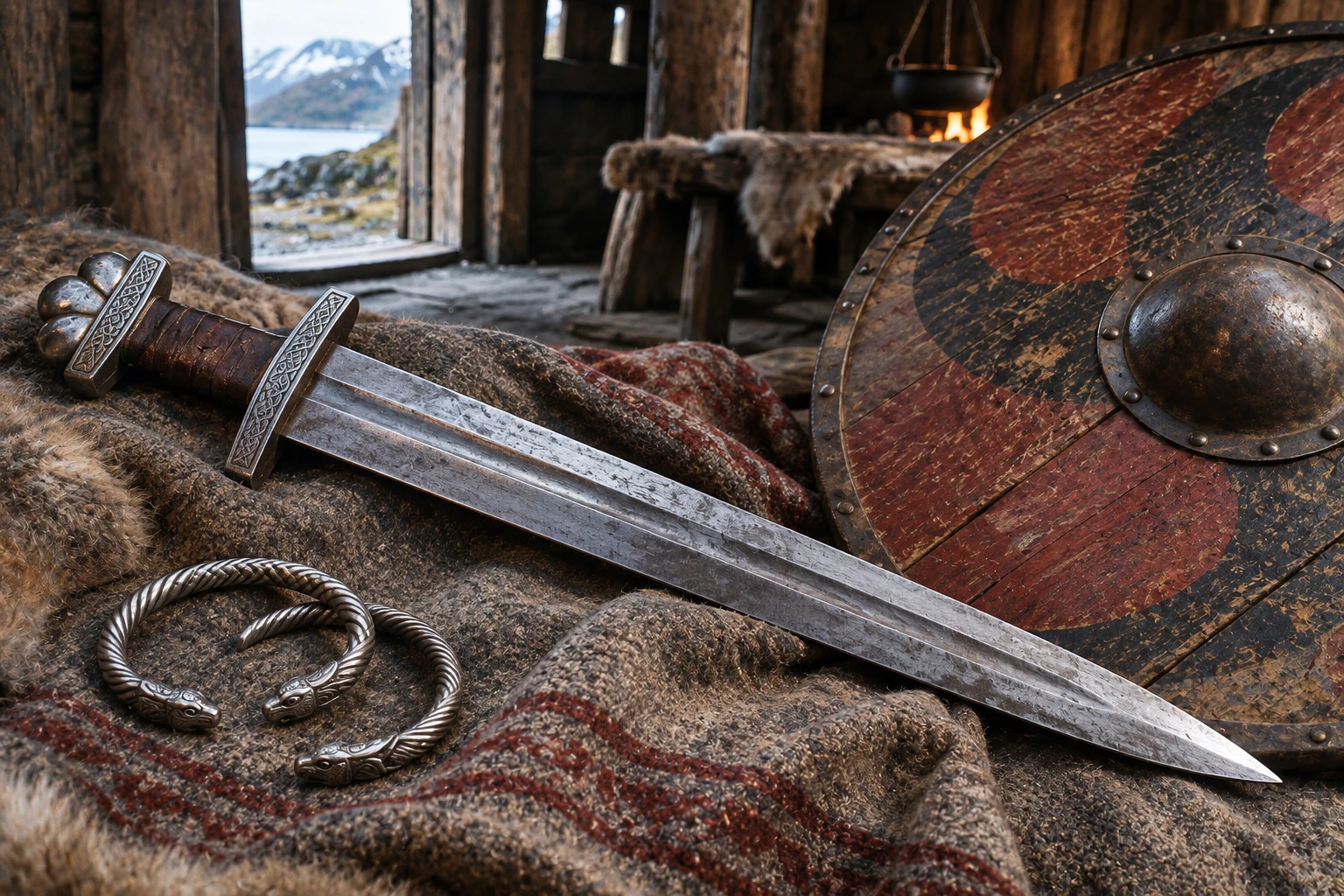
Artist’s reconstruction of a Viking-Age sword with a broad double-edged blade, short crossguard, and multi-lobed pommel, accompanied by a round shield and silver arm rings.
Viking-Age Swords
Not every Viking-Age sword was made in Scandinavia.
Blades, fittings, and finished weapons traveled through trade networks, and some examples reflect manufacturing traditions from other parts of Europe.
Certain blades bear inscriptions such as +VLFBERH+T, commonly associated with a group of early medieval European swords.
These inscriptions have attracted considerable interest, but they do not indicate that every sword bearing such a mark was made by one individual or from one identical material.
Viking-Age swords were valuable objects, and some were richly decorated.
The Medieval Longsword
During the later Middle Ages, European sword designs diversified further.
One important development was the longsword, commonly associated with a grip long enough for two-handed use.
Longswords varied considerably in shape and proportions.
Some emphasized cutting performance, while others were designed with features useful for thrusting against gaps in armor.
Historical fencing manuscripts reveal sophisticated systems of swordsmanship, including guards, footwork, thrusts, cuts, and close-range techniques.
The medieval sword was not simply a heavy piece of sharpened iron.
It was a carefully engineered tool whose form reflected the fighting methods of its time.
5. India: The Talwar, Khanda, and the Story of Crucible Steel
The Indian subcontinent possesses an extraordinarily rich history of swordmaking.
Different regions and periods produced a wide variety of blades, influenced by local traditions, warfare, craftsmanship, and cultural exchange.
The Khanda
The khanda is a straight, double-edged sword associated with several Indian martial traditions.
Historical examples vary in construction and appearance, but many feature broad blades and distinctive hilts.
The khanda also carries ceremonial and symbolic significance in certain cultural contexts.
The Talwar
The talwar, often spelled tulwar, is a curved sword widely associated with South Asian sword traditions.
Its form and construction varied by region and period.
Many examples were designed for effective cutting, and the distinctive disc-shaped pommel found on numerous talwars makes their hilts readily recognizable.
The Extraordinary History of Wootz Steel
India also played a major role in the history of high-carbon crucible steel.
Steel produced through crucible processes in parts of South Asia became known for its quality and was traded across considerable distances.
Some historical crucible steels developed distinctive surface patterns associated with the famous Damascus blades of later centuries.
However, historical crucible-steel Damascus and modern pattern-welded Damascus are different metallurgical traditions.
The story of wootz steel reminds us that advanced metallurgy was practiced in multiple regions long before modern industrial steelmaking.
6. China: The Jian and the Dao
Chinese swordmaking developed over many centuries, producing distinctive designs for military, ceremonial, and personal use.
Two especially important categories are the jian and the dao.
The Jian
The jian is traditionally a straight, double-edged sword.
Its history extends back into ancient China, with bronze examples preceding later iron and steel versions.
The jian became associated with both practical swordsmanship and cultural symbolism.
Historical examples range from relatively simple military weapons to finely decorated blades.
The Dao
The word dao encompasses a broad family of single-edged Chinese blades, including swords and sabers.
Different forms developed across Chinese history, and their shapes varied according to period, purpose, and regional influence.
Some had relatively straight blades; others were distinctly curved.
It would be misleading to imagine one unchanging Chinese sword design.
Chinese swordmaking was a dynamic tradition influenced by changing military needs, technological developments, and interactions with neighboring cultures.
7. Korea: The Geom, the Do, and a Distinctive Sword Heritage
Korean sword history deserves far more attention than it usually receives in popular discussions of historical blades.
Korea’s long history includes ironworking, military innovation, ceremonial traditions, and sword designs influenced by both local developments and exchanges with neighboring societies.
The Korean terms geom and do are commonly associated with swords, broadly corresponding to double-edged and single-edged forms in many contexts, although historical terminology and classifications can be more complicated.
Swords in Korean History
Archaeological discoveries from the Korean peninsula reveal important developments in iron weapons and sword production during ancient periods.
The Three Kingdoms era and subsequent dynasties saw continuing changes in military equipment and sword design.
During the Joseon dynasty, swords were used in military and ceremonial settings, and surviving examples demonstrate considerable variation in form and decoration.
The hwando, a type of Korean sword associated with military use, is particularly worthy of closer examination.
Korean martial traditions also preserve historical material relating to swordsmanship, including the late Joseon military manual Muyedobotongji, published in 1795.
Korean swords should not be treated merely as copies of Japanese or Chinese designs.
Their history deserves to be studied within Korea’s own political, military, and artistic traditions.
8. Japan: The Katana and the Art of the Swordsmith
Few swords are as internationally recognizable as the Japanese katana.
Its curved blade, distinctive guard, and carefully constructed hilt have become enduring symbols of Japanese swordmaking.
But the katana represents only one chapter in a much longer history.
Earlier Japanese Swords
Early Japanese swords included straight forms, some influenced by continental Asian designs.
Over time, Japanese swordsmiths developed distinctive curved blades, including the tachi, commonly associated with mounted warriors.
The katana became especially prominent in later periods, with methods of wearing and drawing the sword differing from those associated with many earlier tachi.
Traditional Japanese Swordmaking
Japanese swordsmiths developed sophisticated methods of working steel, including the use of tamahagane, traditionally produced in a tatara furnace.
Folding, forging, shaping, hardening, and polishing could all contribute to the finished blade.
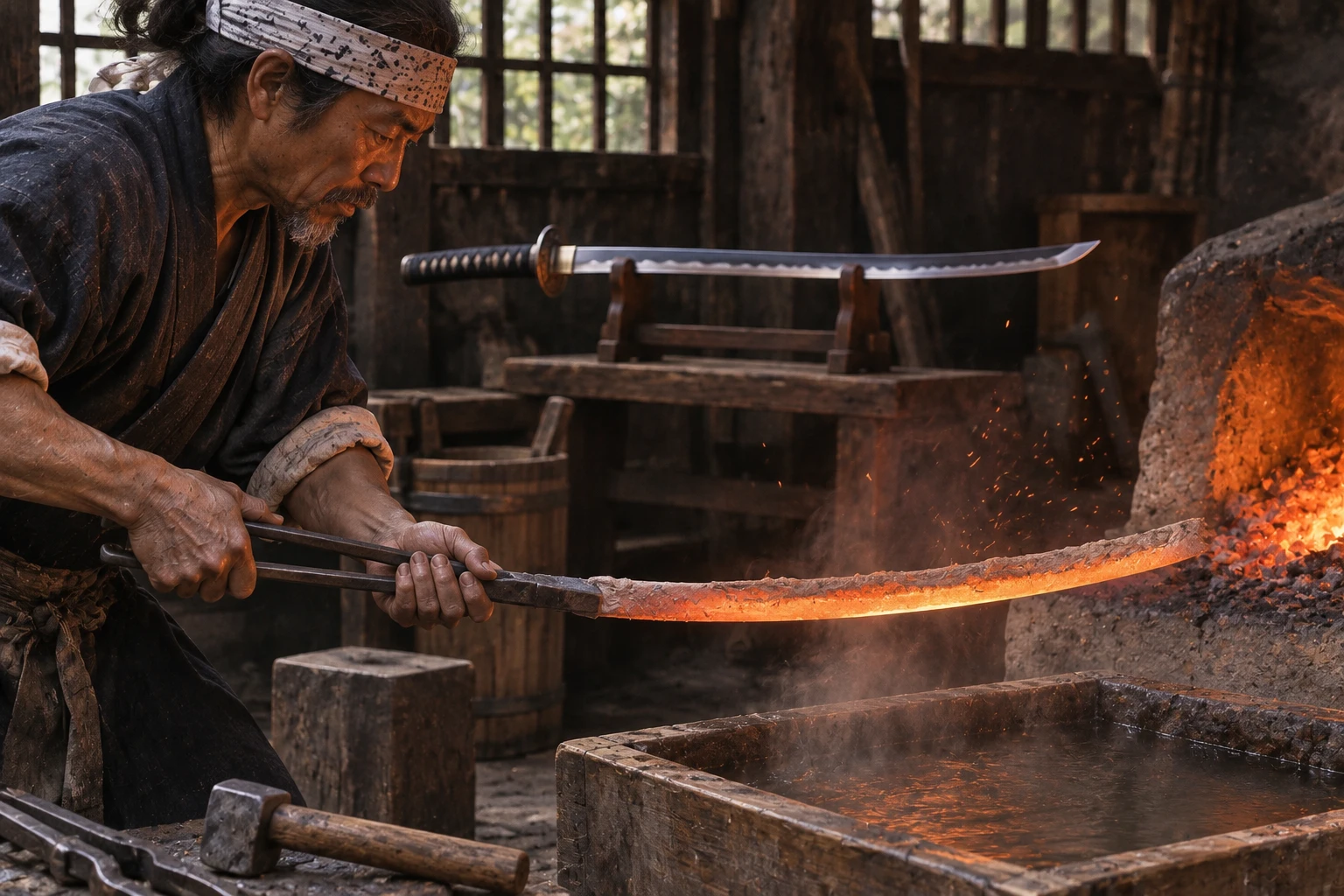
Artist’s reconstruction of a traditional Japanese swordsmith preparing a clay-coated blade for quenching. Differential hardening creates the distinctive hamon, or temper line, revealed through careful polishing.
One particularly recognizable feature of many traditionally made Japanese swords is the hamon, the visible pattern associated with differential hardening.
This process creates different microstructural conditions in the hardened edge and portions of the blade that cool differently.
The katana’s reputation has inspired countless stories, but not all are historically accurate.
It was not an indestructible blade capable of cutting through any material.
Like every sword, its performance depended on metallurgy, geometry, craftsmanship, and appropriate use.
9. Central Asia and the Middle East: The Rise of the Curved Saber
The curved saber became important across large parts of Eurasia, particularly through traditions associated with mounted warfare.
Its development and spread involved many cultures over centuries.
There was no single moment when all curved swords emerged, nor one civilization responsible for every later saber design.
Central Asian Traditions
Various steppe societies developed and used single-edged swords and sabers suited to their military traditions.
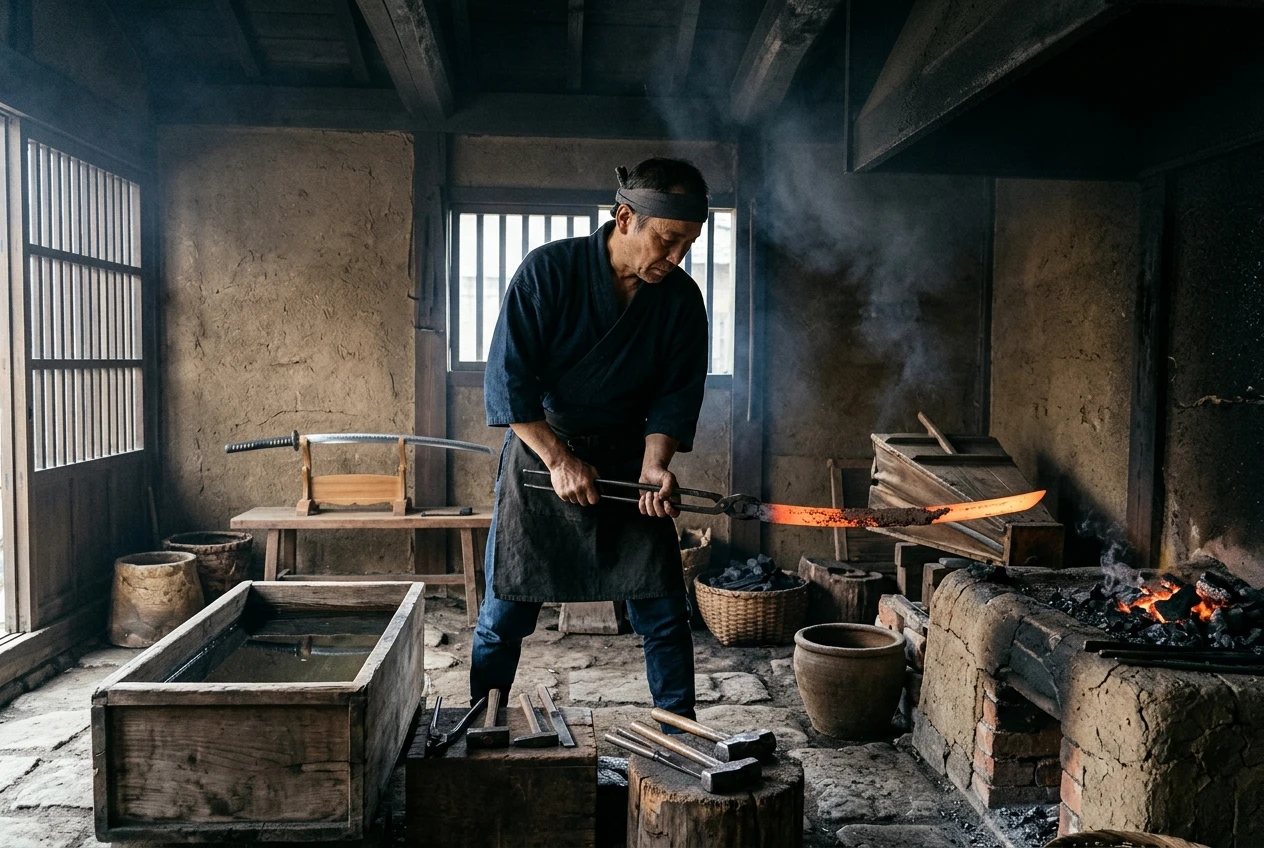
Artist’s reconstruction of a traditional Japanese swordsmith preparing a heated blade for quenching. The carefully controlled cooling process produces differential hardening, which can create the distinctive hamon visible on a finished, polished katana.
Mounted warfare played an important role in the history of many such weapons, although curved blades were also used by fighters on foot.
The movement of peoples, military technologies, and trade helped spread saber designs across regions.
The Persian Shamshir
The shamshir is a distinctive Persian sword type, often characterized by a pronounced curve.
Its elegant profile reflects a sophisticated tradition of blade design and craftsmanship.
Historical shamshirs varied in materials, decoration, and construction.
The Ottoman Kilij
The kilij is associated with Ottoman and related Turkish sword traditions.
Many examples feature curved blades, and some possess a widened section toward the tip known as a yelman.
The kilij became one of several influential saber types in the broader history of Eurasian swords.
The history of these blades illustrates how military technology and artistic craftsmanship moved across cultural boundaries.
10. Africa: A Continent of Remarkable Sword Traditions
African swordmaking is too diverse to be represented by a single design.
Across the continent, different societies developed blades suited to their own environments, technologies, military needs, and cultural traditions.
The Ethiopian Shotel
The shotel is a striking Ethiopian sword known for its strongly curved, sometimes almost sickle-like blade.
Its unusual geometry makes it one of the most visually distinctive historical swords.
The Takouba
The takouba is a straight, double-edged sword associated particularly with Tuareg and other Saharan and Sahelian traditions.
Historical examples often feature distinctive crossguards and decorated hilts.
Beyond These Examples
Other African regions developed numerous sword and blade traditions, including ceremonial and prestige weapons as well as practical military blades.
The histories of these objects are closely connected to regional ironworking, trade, political authority, and artistic expression.
A proper understanding of African blades requires looking beyond a few famous examples and recognizing the continent’s extraordinary cultural diversity.
11. Southeast Asia: The Kampilan, Krabi, and Other Traditions
Southeast Asia has produced some of the world’s most distinctive swords and long blades.
In the Philippines, the kampilan is a long, single-edged sword associated with several southern Philippine traditions.
Its recognizable blade shape and distinctive hilt forms reflect regional craftsmanship and history.
In Thailand, the krabi is associated with traditional sword forms and martial practices, while the broader region includes many varieties of the daab and related blades.
Indonesia and neighboring areas possess rich traditions of edged tools and weapons, including the keris, whose cultural importance extends beyond its function as a blade.
The keris is generally classified as a dagger rather than a sword, but its history belongs in any wider exploration of the world’s bladed craftsmanship.
These traditions remind us that the history of blades cannot be neatly divided into European and East Asian categories.
12. From the Battlefield to the Workshop and Museum
As firearms became increasingly important in warfare, swords gradually lost much of their former battlefield role.
This transition happened at different rates in different places.
Swords continued to serve in cavalry units, ceremonial roles, and military dress long after firearms became dominant.
Today, historical swords survive in museums, private collections, martial traditions, and the workshops of skilled craftspeople.
Some modern smiths reproduce historical designs using traditional methods.
Others combine historical inspiration with modern metallurgy and manufacturing techniques.
Collectors study sword typology, inscriptions, decoration, and construction.
Historians examine archaeological finds and written sources to understand how blades were made and used.
Martial artists preserve or reconstruct historical systems of swordsmanship.
And craftspeople continue to explore the same questions that challenged ancient smiths: how to balance hardness, toughness, edge geometry, and handling.
13. What the World’s Swords Teach Us
Looking across civilizations, several important lessons emerge.
There is no single perfect sword design.
A short Roman infantry sword, a medieval European longsword, a Persian shamshir, and a Japanese katana were created within different technological and cultural contexts.
Comparing them without considering their intended purposes tells us very little.
Steel quality is only one part of performance.
Blade geometry, heat treatment, balance, construction, and the skill of the person using the sword all matter.
Innovation rarely happens in isolation.
Trade, migration, conquest, diplomacy, and craftsmanship helped spread materials, techniques, and designs between societies.
Historical blades are cultural artifacts as well as functional objects.
Their decoration, inscriptions, ceremonial use, and craftsmanship can reveal as much about a society as their cutting edges.
Conclusion: A World Forged in Steel
From the earliest bronze swords to the sophisticated steel blades of later centuries, the sword has followed humanity through extraordinary changes.
Its story stretches across ancient China, India, Korea, Japan, Europe, Africa, the Middle East, Central Asia, and Southeast Asia.
Every region contributed its own traditions, innovations, and artistry.
And behind every surviving historical blade is a human story: a craftsman who shaped it, a society that valued it, and a world in which it had meaning.
At Get Knifed, we’re only beginning this journey.
In our Blades Around the World series, we’ll explore individual sword and knife traditions in greater depth, examining their history, construction, craftsmanship, and cultural significance.
Because the history of the blade isn’t just about steel.
It’s about the people who forged it.
Where the Edge Matters.