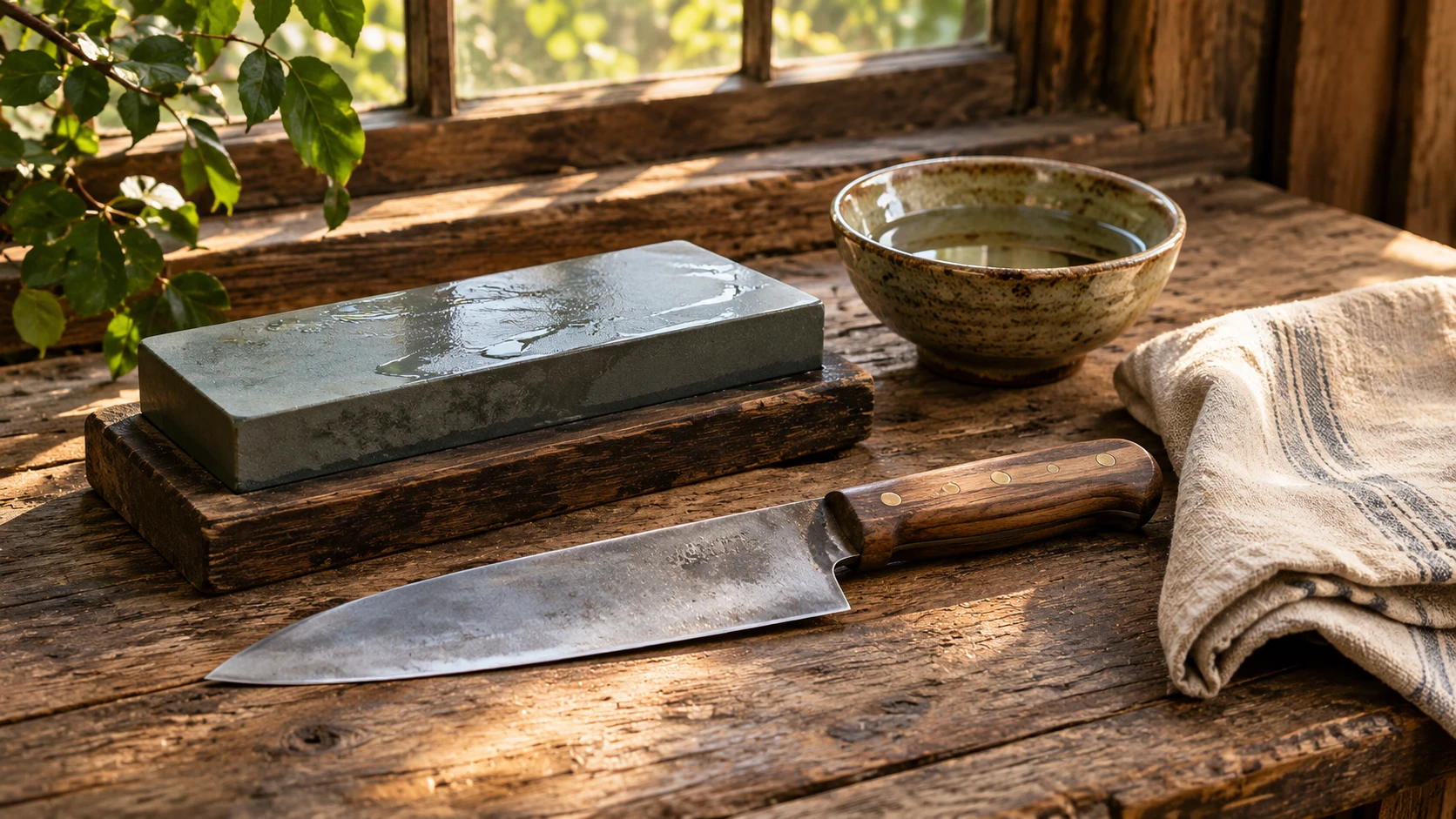
A good knife is an investment, but even the finest knife will eventually lose its edge.
This is not necessarily a sign of poor quality. It is simply the nature of a cutting tool. Every time a blade passes through a piece of food, cardboard, rope, or wood, its cutting edge experiences a small amount of wear.
For centuries, people have maintained their knives using everything from natural stones to carefully engineered sharpening tools.
Today, we have more choices than ever before.
Unfortunately, that abundance of choice can make buying your first knife sharpener almost as confusing as buying your first knife.
Do you need a whetstone? A honing rod? A guided sharpening system? An electric sharpener?
Understanding what each tool does is the first step toward making a sensible choice.
Why Knife Maintenance Matters
Many people spend considerable time researching a knife, only to give little thought to how they will maintain it.
Yet maintenance is part of knife ownership.
A properly maintained kitchen knife requires less unnecessary pressure during ordinary food preparation and can offer better control when used correctly.
Regular care can also extend the useful life of a knife and reduce the temptation to replace it simply because its performance has declined.
Learning about sharpening is therefore not just about convenience. It is about respecting the tools we own and making them last.
Sharpening Versus Honing
Although the words are often used interchangeably, sharpening and honing describe different processes.
Sharpening
Sharpening removes a small amount of material from the blade to restore its cutting edge.
Sharpening stones, abrasive plates, and many mechanical sharpeners accomplish this through abrasion.
Honing
Traditional smooth honing steels primarily help maintain an existing edge through realignment and burnishing.
Some honing rods, particularly ceramic and diamond-coated rods, also remove material and therefore have an abrasive sharpening effect.
Process | Primary Purpose |
|---|---|
Sharpening | Restores a worn cutting edge |
Honing | Helps maintain an existing edge |
Professional repair | Addresses significant damage or specialized maintenance needs |
Understanding this distinction can prevent unnecessary purchases and help you select the appropriate maintenance tool.
The Main Types of Knife Sharpeners
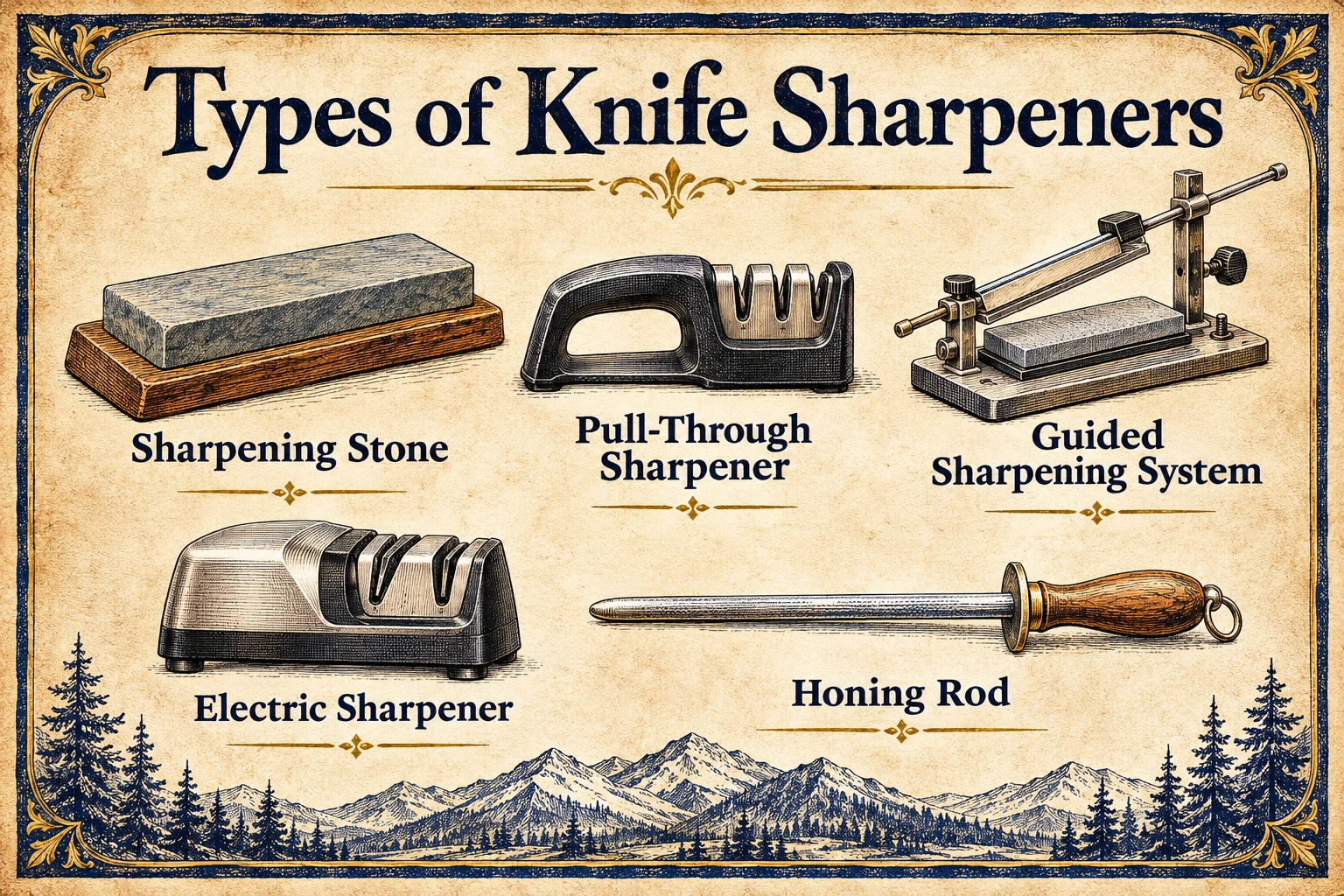
Five common knife maintenance tools, from traditional sharpening stones to modern guided and electric systems. Each offers a different balance of convenience, precision, and craftsmanship. Honing rods primarily help maintain an existing edge rather than restore a worn one.
1. Sharpening Stones
Sharpening stones, commonly called whetstones, are among the oldest and most enduring methods of blade maintenance.
Interestingly, the word whet means to sharpen. It does not mean to wet.
Not every whetstone requires water.
Sharpening stones may be made from natural minerals or manufactured abrasive materials. Depending on their construction, they may require water, oil, or no lubricant at all.
Advantages:
- Traditional and versatile
- Available in many abrasive grades
- Relatively compact
- Can last for many years
Considerations:
- Require practice
- Some stones require periodic flattening
- Maintenance requirements vary by material
Sharpening stones appeal particularly to people who enjoy traditional craftsmanship and hands-on learning.
2. Pull-Through Sharpeners
Pull-through sharpeners are compact devices containing preset abrasive slots.
Their popularity comes largely from their simplicity and convenience.
Advantages:
- Compact
- Generally affordable
- Easy to store
- Require relatively little setup
Considerations:
- Limited compatibility with certain blade designs
- Some models remove more material than necessary
- Preset designs may not suit every knife
For ordinary household kitchen knives, a compatible, well-made pull-through sharpener may be a convenient option.
Always check the knife manufacturer’s maintenance recommendations before choosing one.
3. Guided Sharpening Systems
Guided sharpening systems use a mechanical arrangement to help maintain a consistent relationship between the abrasive and the blade.
They are popular among people who prefer greater consistency and less dependence on freehand technique.
Advantages:
- Designed for repeatable results
- Often offer interchangeable abrasives
- Reduce some of the uncertainty associated with freehand sharpening
Considerations:
- Can be more expensive
- May require additional setup
- Compatibility varies according to blade size and shape
For someone who owns several knives, a guided system may represent a worthwhile long-term investment.
4. Electric Knife Sharpeners
Electric sharpeners use powered abrasive mechanisms to maintain compatible blades.
They are particularly appealing to people who value convenience.
Advantages:
- Quick and convenient
- Generally straightforward to operate
- Useful for routine household maintenance when compatible
Considerations:
- Require electricity
- Can be relatively expensive
- Some models remove excessive material
- May not accommodate specialized blade designs
A quality electric sharpener can be useful in a busy kitchen, but it is important to choose one appropriate for the knives you own.
5. Honing Rods
Honing rods are familiar fixtures in many professional and home kitchens.
They are available in traditional steel, ceramic, and diamond-coated varieties.
Their maintenance effects differ depending on the material and surface texture.
A traditional honing steel is not a universal substitute for a sharpener, particularly when a blade has become substantially worn.
Comparing Knife Sharpeners
Sharpener Type | Learning Curve | Convenience | Typical Application |
|---|---|---|---|
Sharpening stone | Higher | Moderate | Traditional blade maintenance |
Pull-through | Low | High | Compatible household knives |
Guided system | Moderate | Moderate | Consistent, repeatable maintenance |
Electric sharpener | Low | High | Routine kitchen maintenance |
Honing rod | Moderate | High | Regular edge upkeep |
There is no single system that is best for everyone.
The right choice depends on the knives you own, your budget, and how much time you want to devote to their care.
Understanding Sharpening Stone Materials
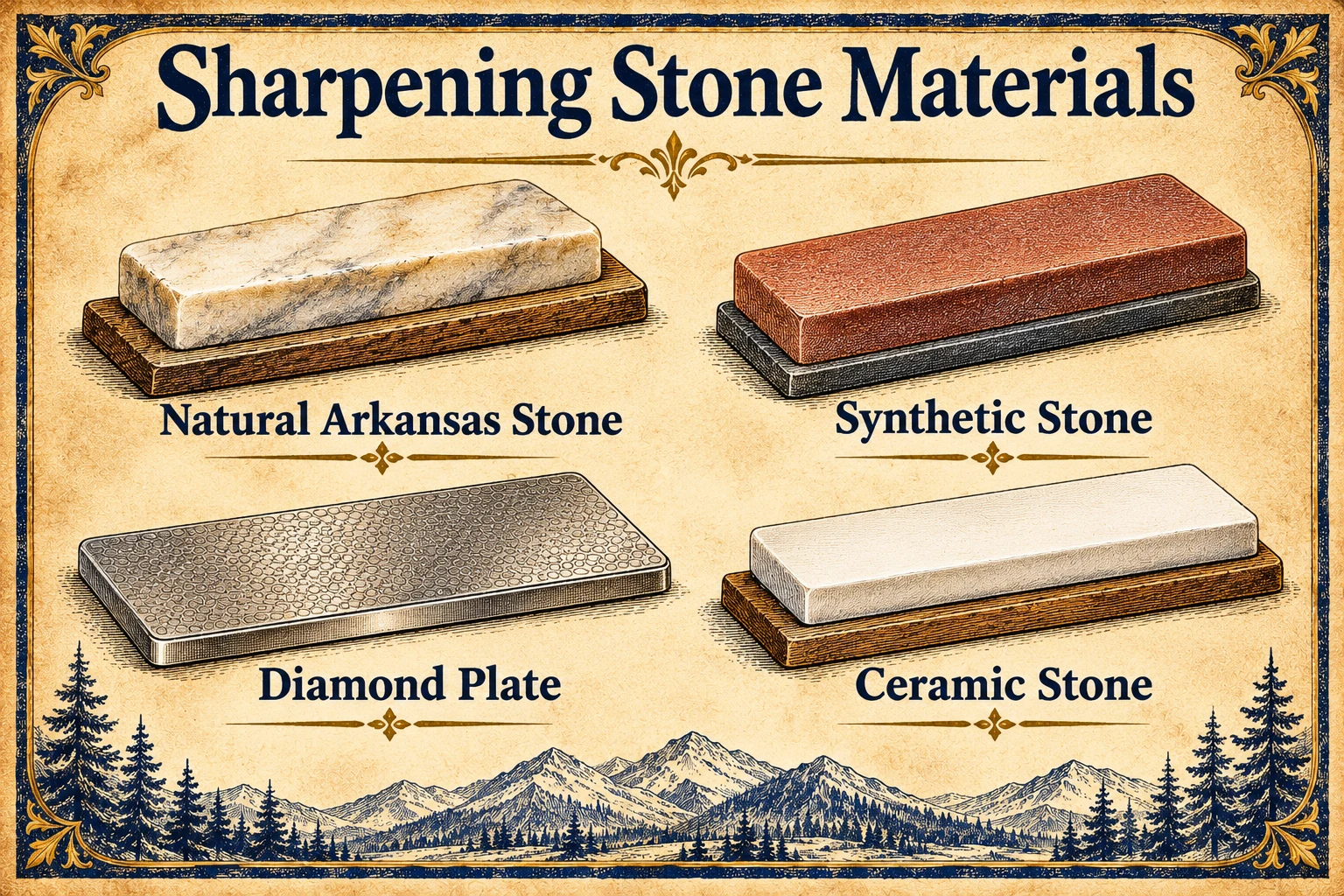
Four common sharpening materials: natural novaculite, synthetic abrasives, industrial diamond plates, and ceramic stones. Each has distinctive properties, maintenance requirements, and applications.
If you are interested in traditional sharpening stones, you will encounter several different materials.
Natural Stones
Natural sharpening stones are quarried from geological deposits.
Arkansas stones, for example, are made from novaculite, a naturally occurring silica-rich rock.
Natural stones have a long history and are often appreciated for their craftsmanship and distinctive characteristics.
Synthetic Stones
Synthetic stones are manufactured using abrasive particles such as aluminum oxide or silicon carbide.
Their controlled manufacturing processes allow producers to offer a broad range of abrasive grades and characteristics.
Diamond Plates
Diamond sharpening plates contain industrial diamond particles bonded to a supporting surface.
They are valued for their durability and ability to abrade hard materials.
Ceramic Abrasives
Ceramic abrasives are available in stones, rods, and other maintenance tools.
They are commonly appreciated for their wear resistance and relatively low maintenance requirements.
Each material has its advantages. Compatibility, quality, and manufacturer recommendations matter more than choosing the most expensive option.
What Does Grit Mean?
When shopping for sharpening stones, you will frequently encounter the term grit.
Grit describes the relative size of the abrasive particles in a sharpening material.
Coarser abrasives remove material more rapidly, while finer abrasives produce a more refined surface.
However, grit numbers are not universally standardized. Two stones carrying the same numerical grit designation may behave differently if they use different grading systems or abrasive materials.
For a beginner, understanding these broad differences is more useful than becoming overwhelmed by numerical specifications.
Do All Knives Require the Same Sharpener?
No.
Different knife designs may require different maintenance tools.
A conventional Western kitchen knife, a traditional Japanese kitchen knife, and a serrated bread knife can have substantially different edge geometries.
Some knives also feature specialized coatings, unusual blade shapes, or manufacturer-specific maintenance requirements.
Before purchasing a sharpener, consider:
- The types of knives you own
- Whether their blades are straight or serrated
- The manufacturer’s maintenance recommendations
- Whether the sharpener is compatible with their design
- Whether professional servicing is available
An unsuitable sharpener can permanently alter a blade or shorten its useful life.
When in doubt, consult the knife manufacturer or a reputable professional sharpening service.
How Much Should You Spend?
As with knives themselves, price does not always determine suitability.
A simple, well-made sharpening tool may provide excellent value for someone who owns only a few kitchen knives.
A more elaborate system may make sense for someone who owns a varied collection or particularly enjoys tool maintenance.
Before spending money, ask yourself whether you want a convenient maintenance tool or whether you are interested in learning sharpening as a traditional craft.
These are two perfectly reasonable approaches, but they may lead to different purchases.
Common Mistakes When Buying a Knife Sharpener
Assuming Every Sharpener Works With Every Knife
Blade geometry and construction vary considerably. Compatibility should always come first.
Buying Too Many Accessories
A beginner does not necessarily need an extensive collection of stones, rods, and mechanical systems.
Confusing Honing With Sharpening
An edge-maintenance tool may not be capable of restoring a substantially worn blade.
Overlooking Material Removal
Sharpening removes material. Unnecessary or overly aggressive maintenance can reduce the life of a knife.
Neglecting Everyday Knife Care
Proper washing, drying, storage, and appropriate cutting surfaces can reduce unnecessary wear.
When to Consider Professional Sharpening
Not everyone needs to sharpen their own knives.
Professional sharpening may be particularly appropriate for valuable knives, antiques, specialized Japanese blades, serrated knives, or blades with significant damage.
Many manufacturers also offer sharpening or maintenance services for their own products.
If you are uncertain about maintaining a treasured knife, professional care may be a better investment than experimenting with an unfamiliar tool.
Your First Knife Sharpener Checklist
Before purchasing your first sharpener, ask yourself:
- What kinds of knives do I own?
- Is this sharpener compatible with them?
- How much maintenance am I comfortable performing myself?
- Do I prefer convenience or traditional craftsmanship?
- Does the manufacturer provide clear instructions?
- Would professional sharpening better suit my needs?
The best sharpener is not necessarily the most sophisticated one.
It is the one that fits your needs and helps you care responsibly for the knives you already own.
The Art of Maintaining What We Own

A well-made knife, cared for over the years, becomes a trusted companion in the everyday rituals of life.
We live in a world where replacing something is often easier than repairing it.
A dull knife is discarded. A worn tool is replaced. An object that might have served us for decades is forgotten in favor of something new.
Knife maintenance offers a small but meaningful alternative to that habit.
There is satisfaction in preserving a useful object, understanding its materials, and appreciating the craftsmanship that went into its creation.
A well-made knife can accompany us through countless meals, camping trips, and ordinary moments of daily life.
Learning to care for it is part of the pleasure of owning it.
Sometimes, the best knife you can buy is the one you already have.
Get Knifed — Where the Edge Matters.