
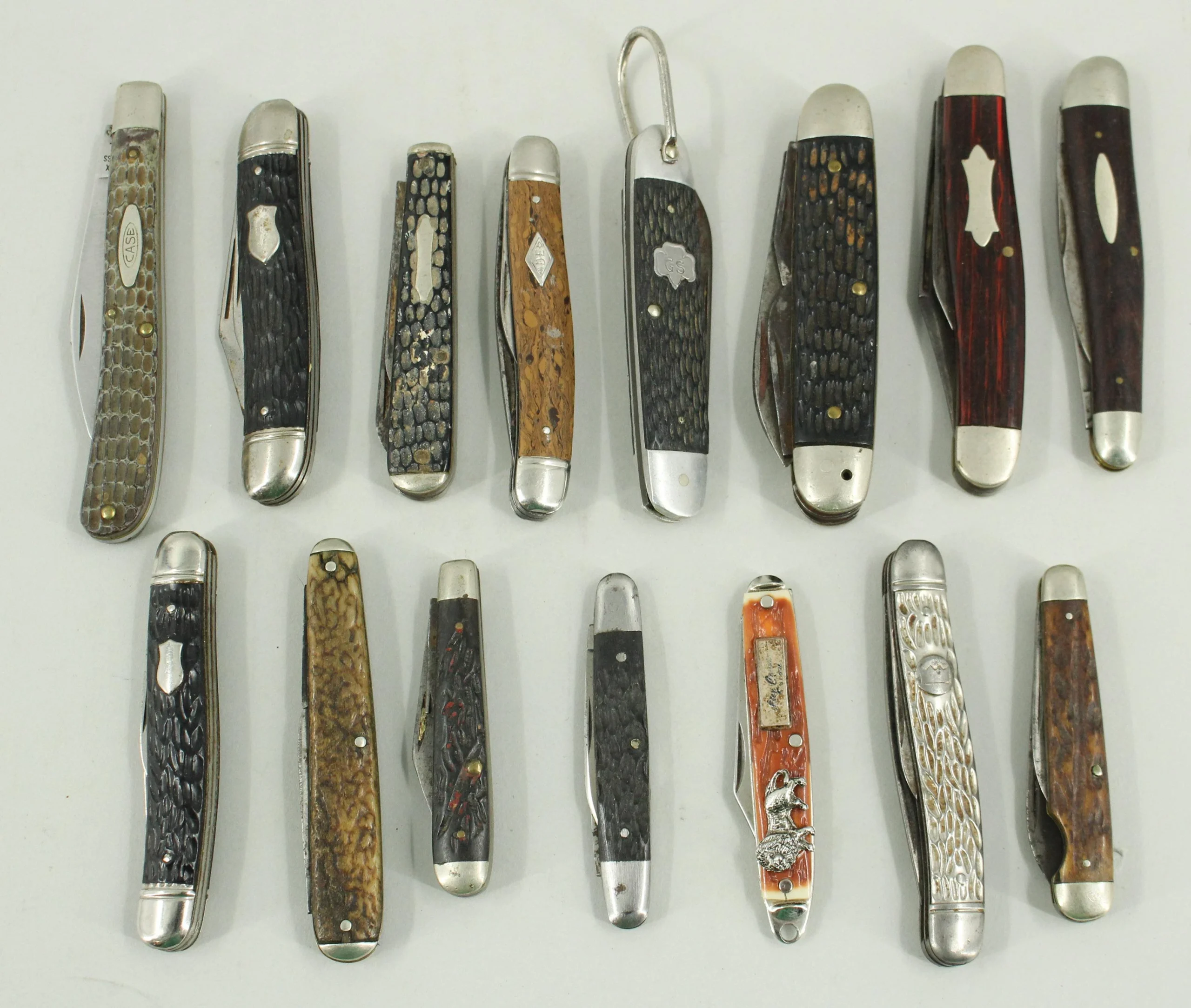
Traditional American pocketknives, reminiscent of the one my father carried every day.
I remember my dad’s pocketknife. He never went anywhere without it. It lived in the pocket of his Levi’s, as much a part of his day as his coffee and his black-and-white ChapStick. Even now, I can picture exactly how that knife looked and how it felt in my hand. Smooth where his hand had held it year after year.
I also remember the thrill of getting my very first pocketknife, a red Victorinox Swiss Army knife. Finally having a knife of my own, something useful I could carry everywhere, felt wonderful. It was a small piece of what my father had taught me, handed down.
Not long after I got it, I used that knife to help someone having car trouble on the side of the road. I can’t remember exactly what needed fixing, but I remember the satisfaction of having a handy tool when someone needed help.
A definite must for a bug out bag!
There’s something satisfying about a good pocketknife. It doesn’t need to be expensive, elaborate, or intimidating. It simply needs to do its job—and do it well.
Perhaps you remember a grandfather pulling a worn pocketknife from his trousers to cut a piece of twine or sharpen a pencil. Maybe you’ve admired the craftsmanship of a beautifully made folding knife. Or perhaps you’ve simply grown tired of wrestling with stubborn packaging.
Whatever brought you here, choosing your first pocketknife is worth a little thought.
Walk into a knife shop—or browse online—and you’ll encounter hundreds of choices. Different steels, blade shapes, locking mechanisms, handle materials, and price points compete for your attention.
But here’s the secret: The best first pocketknife isn’t necessarily the sharpest-looking, most expensive, or most technologically advanced. It’s the one you’ll actually use.
Let’s find it.
1. Start With the Job, Not the Knife
Before considering brands, steels, or blade designs, ask yourself a simple question:
What am I going to use this knife for?
For most people, the answer is surprisingly ordinary.
Opening packages. Cutting string. Trimming loose threads. Slicing an apple. Working in the garden. Handling small repairs around the house.
These are everyday cutting tasks, and they don’t require an enormous blade or an elaborate mechanism.
If you’re looking for a knife to carry during normal daily activities, a compact folding knife with a comfortable handle and a blade around 2.5 to 3 inches is a reasonable starting point.
If you spend your days working outdoors, wearing gloves, or cutting tougher materials, you might prefer something slightly larger.
The important thing is to match the knife to your life—not the other way around.
A knife that’s too bulky, awkward, or inconvenient to carry often ends up forgotten in a drawer.
2. Traditional or Modern? Two Paths to the Same Purpose
Pocketknives generally fall into two broad families: traditional slipjoint knives and modern folding knives.
Both have their advantages.
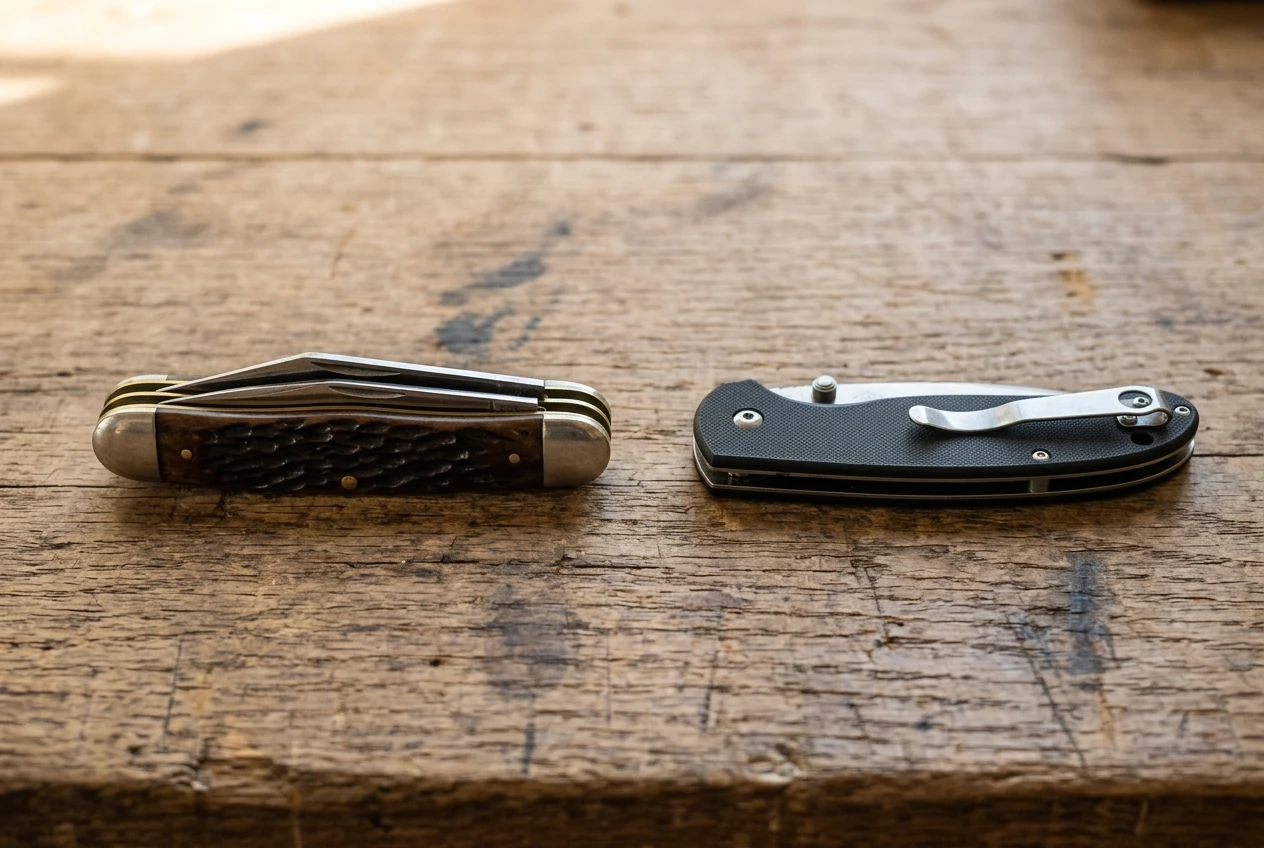
Traditional and modern pocketknives offer different approaches to everyday utility, from classic multi-blade stockman patterns to contemporary single-blade folders.
Traditional Pocketknives
Think of the classic penknife, stockman, or trapper: familiar shapes, often with attractive wood, bone, or synthetic handles.
Many traditional knives use a slipjoint mechanism, meaning a spring provides resistance to closing but does not lock the blade open.
Their appeal lies in simplicity, craftsmanship, and versatility. Some offer two or three blades for different tasks.
They’re particularly well suited to light everyday cutting.
However, because the blade doesn’t lock, users must be especially mindful of pressure applied toward the closing direction.
Modern Folding Knives
Modern folders often feature one-handed opening mechanisms, pocket clips, textured handles, and locking blades.
Common locking systems include liner locks, frame locks, and crossbar-style locks.
A properly functioning lock helps resist accidental blade closure during normal use, but no locking mechanism makes a knife foolproof.
Modern designs can be wonderfully practical, especially when convenience and secure handling matter.
Neither category is inherently better.
A traditional slipjoint might suit someone who appreciates simplicity and heritage. A modern locking folder may appeal to someone who wants a pocket clip and easy access.
Choose according to your needs and preferences.
3. Blade Shape: Why the Drop Point Is a Good Beginning
Blade shapes aren’t merely decorative. They influence how a knife cuts, how easily its point can be controlled, and which tasks it performs best.
For a first pocketknife, I particularly like the drop-point blade.
Its spine slopes gently toward the tip, creating a strong, controllable point and a useful cutting edge.
It’s a versatile design suitable for many everyday jobs.
Other common shapes include:
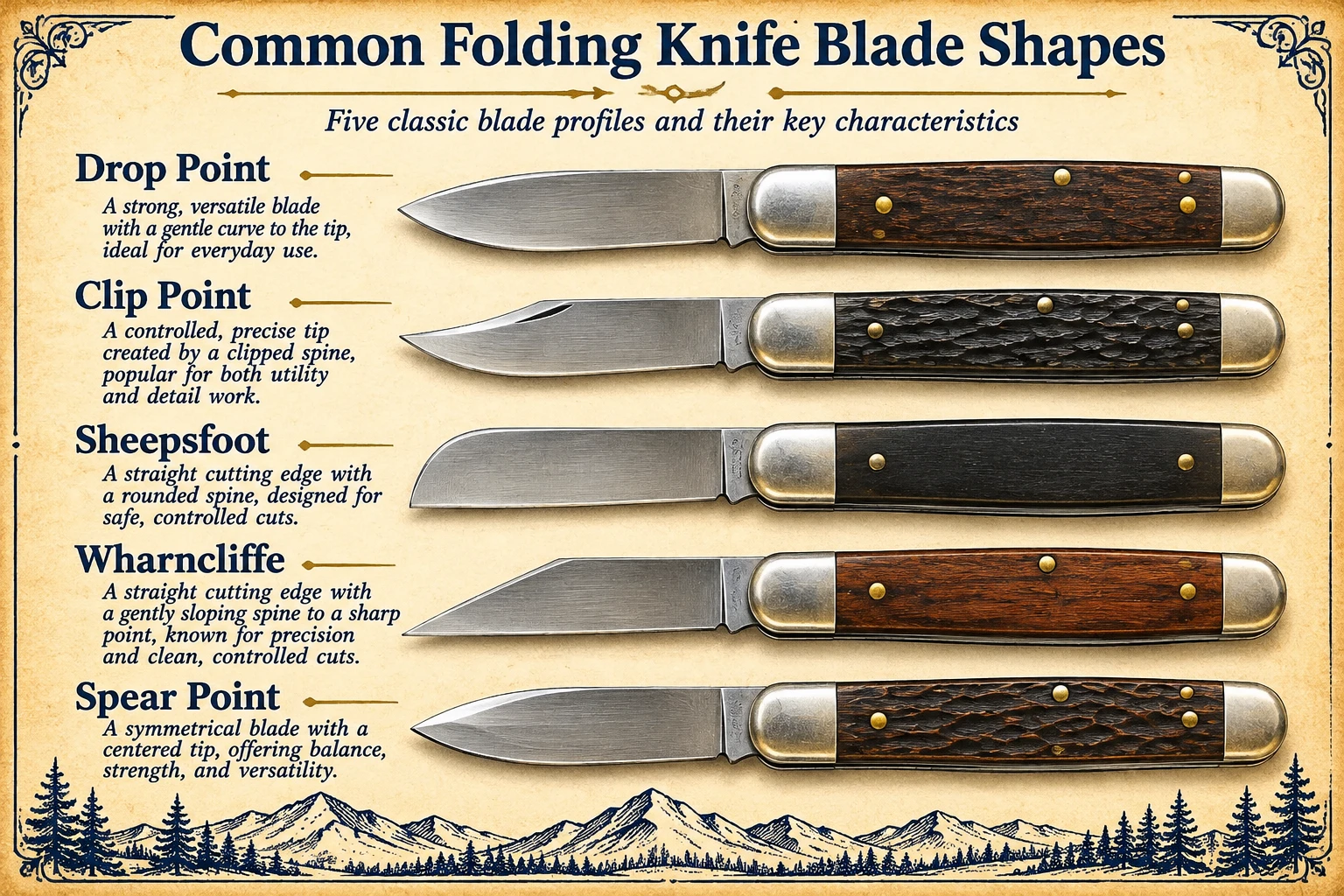
Five classic pocketknife blade profiles, each designed with different cutting tasks in mind.
Clip point: Features a spine that appears to have a portion clipped away near the tip. Often provides a fine point useful for detailed cutting, although the tip can be relatively delicate.
Sheepsfoot: Has a relatively straight cutting edge and a spine that curves downward toward the tip. Useful for controlled slicing when a sharply pointed tip isn’t needed.
Wharncliffe: Typically combines a straight cutting edge with a spine that tapers toward a more acute point. Excellent for precise utility cuts.
Spear point: Has a generally symmetrical profile, with the tip near the blade’s centerline. Its suitability depends on the particular grind and design.
For most beginners, a plain-edged drop point offers an excellent balance of versatility, ease of sharpening, and control.
You don’t need an exotic blade shape to get excellent performance.
4. What About Blade Steel?
Here’s where knife shopping can become unnecessarily complicated.
You’ll encounter combinations of letters and numbers that sound more like laboratory formulas than something you’d use to open a cardboard box.
8Cr13MoV. 14C28N. D2. S30V. MagnaCut.
Each represents a steel with particular characteristics, but you don’t need to memorize them all.
For your first knife, concentrate on three practical qualities:
Edge retention: How well the blade maintains a useful cutting edge during use.
Corrosion resistance: How well the steel resists rust and staining.
Ease of sharpening: How readily you can restore the cutting edge with appropriate sharpening tools.
These characteristics involve trade-offs. Heat treatment and blade geometry also influence performance, sometimes dramatically.
A high-end steel isn’t automatically the best choice for a beginner.
For example, 14C28N is a stainless steel that can offer an appealing combination of corrosion resistance, toughness, and sharpening ease when properly heat-treated.
8Cr13MoV can also serve well in an affordable knife when the manufacturer gets the heat treatment and geometry right.
D2 offers good wear resistance but is less corrosion-resistant than many stainless knife steels.
Premium steels may offer advantages, but they aren’t necessary for ordinary daily cutting.
A well-made knife with modest steel is often a better purchase than a poorly executed knife boasting an expensive alloy.
Related reading: Our guide to knife steels explores the differences in greater detail.
5. Handle Comfort Matters More Than You Think
A pocketknife can have excellent steel and a beautifully ground blade, yet still be unpleasant to use.
The handle is your connection to the tool.
It should feel secure, comfortable, and appropriately sized for your hand.
Common handle materials include:
- G10: A durable fiberglass laminate offering strength and often a textured grip.
- Micarta: A resin-based composite commonly made with fabric or paper, appreciated for its feel and appearance.
- Wood: Traditional, attractive, and available in many varieties, although some woods require more care.
- Aluminum: Lightweight and rigid, with grip depending heavily on its surface texture and design.
- FRN and similar reinforced polymers: Lightweight, durable materials commonly found on practical working knives.
No material guarantees a comfortable handle. Shape and ergonomics matter just as much.
Pay attention to sharp corners, uncomfortable finger grooves, and handles that force your fingers into awkward positions.
If possible, handle a knife before buying it.
Open and close it safely. Notice how it sits in your palm. Check whether your fingers have adequate room.
And remember that hand size varies. A knife praised by someone with large hands may feel awkward to someone with smaller ones.
A good knife should fit its owner.
6. Locking Mechanisms: Understand What You’re Holding
If you choose a locking folder, it’s worth understanding how the lock works.
Three common designs are:
Liner lock: A spring-like section of the handle liner moves behind the blade tang when opened, resisting closure.
Frame lock: Similar in principle to a liner lock, but uses part of the handle frame itself.
Crossbar lock: Uses a spring-loaded bar that engages the blade tang. Designs vary among manufacturers.
Each system has strengths and limitations.
More important than choosing a fashionable mechanism is selecting a well-constructed knife from a reputable manufacturer.
Learn the proper opening and closing procedure before carrying it.
Keep your fingers clear of the blade’s path, inspect the mechanism periodically, and never assume a lock makes improper cutting techniques safe.
A folding knife should not be used for prying, twisting, or tasks that require a more suitable tool.
7. How Much Should Your First Pocketknife Cost?
You can spend surprisingly little—or several hundred dollars—on a pocketknife.
Fortunately, you don’t need to spend a fortune to get a dependable everyday tool.
Here are useful shopping ranges rather than fixed rules:
Budget | What to Expect |
|---|---|
Under $25 | Basic utility knives and some worthwhile entry-level options; quality varies |
$25–$60 | Many practical everyday knives with decent materials and construction |
$60–$120 | More choices in handle materials, steels, fit, finish, and mechanisms |
Over $120 | Premium materials, refined construction, specialized designs, and collector appeal |
For a first pocketknife, roughly $30–$70 is a sensible shopping range.
There are excellent exceptions above and below it.
I’d rather see a beginner buy a modest, dependable knife and learn to maintain it than spend $200 on a blade they’re afraid to scratch.
A pocketknife is a tool. A few marks from honest use are nothing to be ashamed of.
8. Five Mistakes First-Time Buyers Make
Buying for Appearance Alone
A dramatic blade may look impressive in photographs, but appearance tells you little about comfort, cutting performance, or construction quality.
Consider function first.
Choosing a Knife That’s Too Large
Bigger isn’t necessarily more useful.
A compact, easily controlled blade often handles ordinary tasks better than an oversized folder.
Obsessing Over Premium Steel
Steel matters, but so do heat treatment, edge geometry, ergonomics, and overall construction.
Don’t let technical specifications distract you from the complete knife.
Ignoring Maintenance
Even stainless steel can corrode under unfavorable conditions.
Keep your knife clean and dry, sharpen it appropriately, and maintain the pivot according to the manufacturer’s instructions.
Forgetting Local Knife Laws
Knife laws vary by jurisdiction and sometimes by location within a jurisdiction.
Blade length, opening mechanism, concealment, and restricted places may all affect what you can legally carry.
Check applicable laws before purchasing or carrying a knife, especially when traveling.
9. Learning to Care for Your First Knife
A good pocketknife can provide years of service with relatively simple care.
Wipe the blade clean after use, especially after contact with moisture, food, or corrosive substances.
Dry it thoroughly before storage.
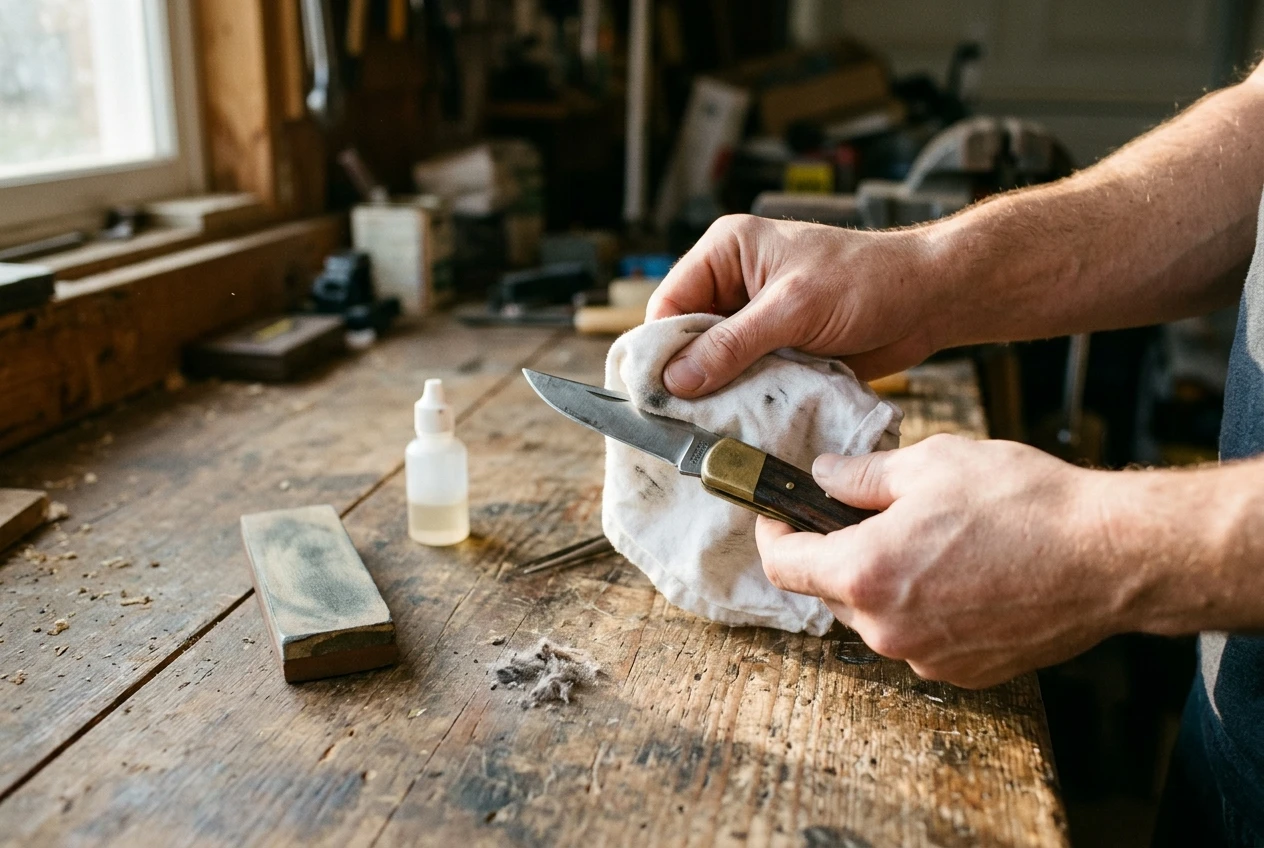
Regular cleaning, careful drying, and occasional lubrication help keep a pocketknife in reliable working condition.
Remove accumulated pocket lint and debris from the pivot area, taking care not to damage the mechanism.
Use lubricants sparingly and according to the manufacturer’s recommendations. If the knife will contact food, choose products appropriate for that purpose.
Learn basic sharpening techniques before the edge becomes severely dull.
A dull knife can encourage excessive force and reduce control. A sharp, properly maintained edge cuts more predictably when used correctly.
And always close and store your knife securely when it’s not in use.
These small habits matter far more than owning the latest steel.
10. Your First Pocketknife Checklist
Before you buy, ask yourself:
- Do I know what I’ll primarily use this knife for?
- Is the blade size appropriate for those tasks?
- Does the handle fit my hand comfortably?
- Do I understand the opening and closing mechanism?
- Is the blade steel suitable for my needs and maintenance habits?
- Am I buying from a reputable manufacturer or retailer?
- Can I maintain and sharpen this knife?
- Have I checked the laws where I intend to carry it?
- Is the price comfortable for my budget?
If you can answer these questions confidently, you’re well on your way.
The Best First Knife Is the One That Becomes Yours
There’s a certain pleasure in owning a pocketknife that fits naturally into your everyday life.
Over time, you learn its balance, its limitations, and how its edge responds to different materials.
Perhaps you’ll eventually explore traditional patterns, premium steels, custom makers, or the history of bladesmithing.
Perhaps you’ll own only one pocketknife for decades.
Either outcome is perfectly respectable.
The goal isn’t to accumulate knives. It’s to understand what makes a good one and choose wisely.
So take your time. Handle a few designs if you can. Learn the basics. Buy something practical.
Then put it to work.
Because the best pocketknife isn’t the one that spends its life in a display case. It’s the one you’ll actually use.
Get Knifed — Where the Edge Matters.